


Page 161 - AJWEP-22-4
P. 161
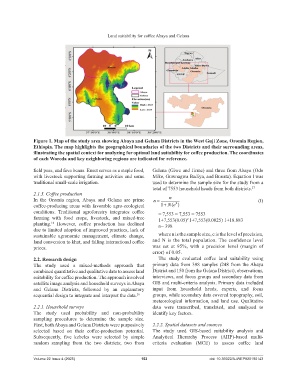
Land suitability for coffee Abaya and Gelana


                Figure 1. Map of the study area showing Abaya and Gelana Districts in the West Guji Zone, Oromia Region,
                Ethiopia. The map highlights the geographical boundaries of the two Districts and their surrounding areas,
                illustrating the spatial context for analyzing for optimal land suitability for coffee production. The coordinates
                of each Woreda and key neighboring regions are indicated for reference.


                field peas, and fava beans. Enset serves as a staple food,   Gelana (Giwe and Jirme) and three from Abaya (Odo
                with livestock supporting farming activities and some   Mike, Guwnagwa Badiya, and Bunata). Equation I was
                traditional small-scale irrigation.                 used to determine the sample size for the study from a
                                                                    total of 7553 household heads from both districts. 27
                2.1.3. Coffee production
                In  the  Oromia  region,  Abaya  and  Gelana  are  prime   n   n                                  (I)
                                                                              2
                coffee-producing areas with favorable agro-ecological   1   Ne()
                conditions.  Traditional  agroforestry  integrates  coffee   = 7,553 = 7,553 = 7553
                farming with food crops, livestock, and mixed-tree     1+7,553(0.05) 1+7,553(0.0025) 1+18.883
                                                                                   2
                planting.   However,  coffee  production  has  declined   n= 398
                        14
                due to limited adoption of improved practices, lack of
                sustainable  agronomic  management,  climate  change,   where n is the sample size, e is the level of precision,
                land conversion to khat, and falling international coffee   and N is the total population. The confidence level
                prices.                                             was  set  at 95%, with  a  precision level  (margin  of
                                                                    error) of 0.05.
                2.2. Research design                                   The  study  evaluated  coffee  land  suitability  using
                The  study used a mixed-methods  approach  that     primary data from 398 samples (248 from the Abaya
                combined quantitative and qualitative data to assess land   District and 150 from the Gelana District), observations,
                suitability for coffee production. The approach involved   interviews, and focus groups and secondary data from
                satellite image analysis and household surveys in Abaya   GIS and multi-criteria analysis. Primary data included
                and  Gelana  Districts,  followed  by  an  explanatory   input  from household  heads, experts,  and focus
                sequential design to integrate and interpret the data. 26  groups, while secondary data covered topography, soil,
                                                                    meteorological  information,  and land use. Qualitative
                2.2.1. Household surveys                            data  were  transcribed,  translated,  and  analyzed  to
                The  study used probability  and  non-probability   identify key factors.
                sampling  procedures  to  determine  the  sample  size.
                First, both Abaya and Gelana Districts were purposively   2.2.2. Spatial datasets and sources
                selected  based  on  their  coffee-production  potential.   The  study  used  GIS-based  suitability  analysis  and
                Subsequently,  five  kebeles  were  selected  by  simple   Analytical  Hierarchy Process (AHP)-based multi-
                random  sampling  from  the  two  districts;  two  from   criteria  evaluation  (MCE)  to  assess  coffee  land


                Volume 22 Issue 4 (2025)                       153                           doi: 10.36922/AJWEP025190143

