


Page 44 - AJWEP-22-4
P. 44
Qin, et al.

                                                                    after 2006, SER in the NWC shifted from being
                                                                    primarily influenced by temperature to being controlled
                                                                    by ASC.
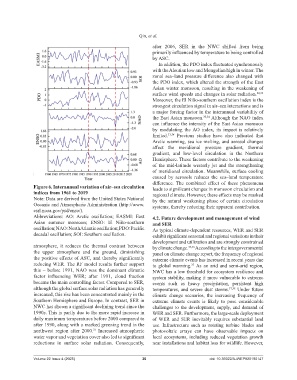
                                                                       In addition, the PDO index fluctuated synchronously
                                                                    with the Aleutian low and Mongolian high in winter. The
                                                                    zonal  sea–land  pressure  difference  also  changed  with
                                                                    the PDO index, which altered the strength of the East
                                                                    Asian winter monsoon, resulting in the weakening of
                                                                    surface wind speeds and changes in solar radiation. 32,33
                                                                    Moreover, the El Niño-southern oscillation index is the
                                                                    strongest circulation signal in air–sea interactions and is
                                                                    a major forcing factor in the interannual variability of
                                                                    the East Asian monsoon. 33,34  Although the NAO index
                                                                    can influence the intensity of the East Asian monsoon
                                                                    by modulating  the AO index, its impact  is relatively
                                                                    limited. 33,34   Previous studies  have  also  indicated  that
                                                                    Arctic warming, sea ice melting, and aerosol changes
                                                                    affect  the  meridional  pressure  gradient,  thermal
                                                                    gradient,  and low-level  circulation  in the Northern
                                                                    Hemisphere. These factors contribute to the weakening
                                                                    of the mid-latitude westerly jet and the strengthening
                                                                    of meridional circulation. Meanwhile, surface cooling
                                                                    caused by aerosols reduces the sea–land temperature
                                                                    difference.  The  combined  effect  of  these  phenomena
                Figure 6. Interannual variation of air–sea circulation   leads to significant changes in monsoon circulation and
                indices from 1961 to 2019                           regional climate. However, these effects may be masked
                Note: Data are derived from the United States National   by the natural weakening phase of certain circulation
                Oceanic and Atmospheric Administration (http://www.  systems, thereby reducing their apparent contribution.
                esrl.noaa.gov/psd/enso/).
                Abbreviations:  AO:  Arctic  oscillation;  EASMI:  East   4.2. Future development and management of wind
                Asian  summer  monsoon;  ENSO:  El  Niño-southern   and SER
                oscillation; NAO: North Atlantic oscillation; PDO: Pacific   As typical climate-dependent resources, WER and SER
                decadal oscillation; SOI: Southern oscillation.     exhibit significant seasonal and regional variations in their
                                                                    development and utilization and are strongly constrained
                atmosphere, it  reduces  the  thermal  contrast  between   by climate change. 35,36  According to the intergovernmental
                the upper atmosphere and the ground, diminishing    panel on climate change report, the frequency of regional
                the positive effects of ASC, and thereby significantly   extreme climate events has increased in recent years due
                reducing WER. The RF model results further support   to global warming.  As an arid and semi-arid region,
                                                                                     37
                this – before 1991, NAO was the dominant climatic   NWC has a low threshold for ecosystem resilience and
                factor  influencing  WER;  after  1991,  cloud  fraction   system stability, making it more vulnerable to extreme
                became the main controlling factor. Compared to SER,   events such as heavy precipitation, persistent high
                although the global surface solar radiation has generally   temperatures, and severe dust storms. 37,38  Under future
                increased, this rise has been concentrated mainly in the   climate change scenarios, the increasing frequency of
                Southern Hemisphere and Europe. In contrast, SER in   extreme climate events is likely to pose considerable
                NWC has shown a significant declining trend since the   challenges to the development, supply, and demand of
                1990s. This is partly due to the more rapid increase in   WER and SER. Furthermore, the large-scale deployment
                daily maximum temperatures before 2000 compared to   of  WER and SER inevitably requires substantial land
                after 1990, along with a marked greening trend in the   use. Infrastructure such as rotating turbine blades and
                northwest region after 2000.  Increased atmospheric   photovoltaic arrays can have observable impacts on
                                          31
                water vapor and vegetation cover also led to significant   local ecosystems, including reduced vegetation growth
                reductions in surface solar radiation. Consequently,   near installations and habitat loss for wildlife. However,


                Volume 22 Issue 4 (2025)                        36                           doi: 10.36922/AJWEP025190147

