


Page 43 - AJWEP-22-4
P. 43
Spatiotemporal variability and climate forcing mechanisms

                              A                                     B


                              C                                     D


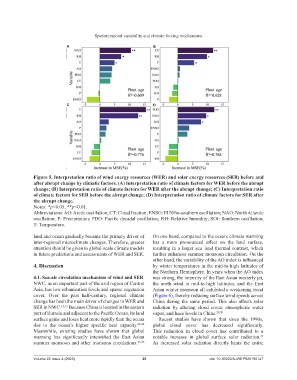
                Figure 5. Interpretation ratio of wind energy resources (WER) and solar energy resources (SER) before and
                after abrupt change by climatic factors. (A) Interpretation ratio of climate factors for WER before the abrupt
                change; (B) Interpretation ratio of climate factors for WER after the abrupt change; (C) Interpretation ratio
                of climate factors for SER before the abrupt change; (D) Interpretation ratio of climate factors for SER after
                the abrupt change.
                Notes: *p<0.05, **p<0.01.
                Abbreviations: AO: Arctic oscillation; CT: Cloud fraction; ENSO: El Niño-southern oscillation; NAO: North Atlantic
                oscillation; P: Precipitation; PDO: Pacific decadal oscillation; RH: Relative humidity; SOI: Southern oscillation;
                T: Temperature.

                land and ocean gradually became the primary driver of   On one hand, compared to the ocean, climate warming
                inter-regional microclimate changes. Therefore, greater   has  a  more  pronounced  effect  on  the  land  surface,
                attention should be given to global-scale climate models   resulting in a larger sea–land thermal contrast, which
                in future predictions and assessments of WER and SER.  further enhances summer monsoon circulation. On the
                                                                    other hand, the variability of the AO index is influenced
                4. Discussion                                       by winter temperatures in the mid-to-high latitudes of
                                                                    the Northern Hemisphere. In years when the AO index
                4.1. Sea-air circulation mechanism of wind and SER  was strong, the intensity of the East Asian westerly jet,
                NWC, as an important part of the arid region of Central   the north wind in mid-to-high latitudes,  and the East
                Asia, has low urbanization levels and sparse vegetation   Asian winter monsoon all exhibited a weakening trend
                cover. Over  the  past  half-century,  regional  climate   (Figure 6), thereby reducing surface wind speeds across
                change has been the main driver of changes in WER and   China during the same period. This also affects solar
                SER in NWC. 12,13  Because China is located in the eastern   radiation by altering cloud cover, atmospheric water
                part of Eurasia and adjacent to the Pacific Ocean, its land   vapor, and haze levels in China. 29,30
                surface gains and loses heat more rapidly than the ocean   Recent studies have shown that since the 1990s,
                due  to  the  ocean’s  higher  specific  heat  capacity. 22-24    global  cloud  cover  has  decreased  significantly.
                Meanwhile,  existing  studies  have  shown that  global   This reduction in cloud cover has contributed to a
                warming  has  significantly  intensified  the  East  Asian   notable  increase  in global surface solar  radiation.
                                                                                                                    31
                summer monsoon and other monsoon circulations. 25-28    As increased solar radiation directly heats the entire


                Volume 22 Issue 4 (2025)                        35                           doi: 10.36922/AJWEP025190147

