


Page 39 - AJWEP-22-4
P. 39
Spatiotemporal variability and climate forcing mechanisms

                    1, x   x j                                    denoted V , and is obtained by integrating the square of

                        i
                                                                             ar
                a          j 12 3,, ,..., i              (VII)   the wavelet coefficient over the time translation domain b.
                 ij
                      0, x   x  j
                        i
                                                                    2.3.3. RF modeling
                  Here, S  is the cumulative number of times the value   The RF algorithm – an ensemble learning framework
                         k
                at time i exceeds the value at time j. When k = 1, S = 0.   initially conceptualized by Breiman – operates through
                                                            1
                Assuming the time series is randomly independent, the   parallelized decision trees to enhance predictive
                statistical variables are defined as:               accuracy while enabling robust quantification of feature
                                                                    importance.  By implementing a bagging technique,
                                                                               20
                          E S )
                       k
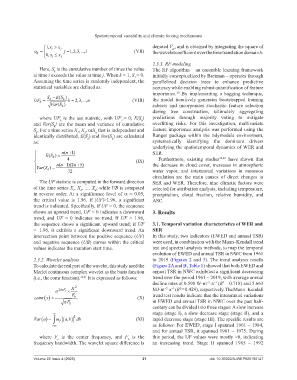
                UF   S  (  k  k  ,,...,23  n            (VIII)   the model iteratively generates bootstrapped training
                  k
                       VarS (  k  )                                 subsets  and  incorporates  stochastic  feature  selection
                                                                    during tree construction,  ultimately  aggregating
                  where UF  is the test statistic, with UF = 0; E(S )   predictions through majority voting to mitigate
                                                               k
                            k
                                                      1
                and Var(S ) are the mean and variance of cumulative   overfitting  risks.  For  this  investigation,  multivariate
                         k
                S . For a time series X , X , orX  that is independent and   feature importance analysis was performed using the
                                           n
                                   1
                                      2
                 k
                identically distributed, E(S ) and Var(S ) are calculated   Ranger package within the tidymodels environment,
                                        k
                                                  k
                as:                                                 systematically identifying the dominant drivers
                                                                    underlying the spatiotemporal dynamics of WER and
                           nn ( 1 )                               SER.
                    ES(  k )                                         Furthermore, existing studies 22,23  have shown that

                              4                             (IX)
                               )(
                 VarS (  )   nn ( 12 n  5 )                     the decrease in cloud cover, increases in atmospheric
                    k        72                                   water vapor, and interannual  variations  in monsoon
                                                                    circulation  are the main  causes of direct  changes in
                  The UF statistic is computed in the forward direction   SER and WER. Therefore, nine climatic factors were
                of the time series X , X , …, X , while UB is computed   selected for attribution analysis, including temperature,
                                           n
                                 1
                                    2
                in  reverse  order. At  a  significance  level  of  α  = 0.05,   precipitation,  cloud  fraction, relative  humidity, and
                the critical  value  is 1.96. If |UF|>1.96,  a  significant   ASC.
                trend is indicated. Specifically, if UF > 0, the sequence
                shows an upward trend, UF < 0 indicates a downward   3. Results
                trend,  and  UF  =  0  indicates  no  trend.  If  UF  >  1.96,
                the sequence shows a significant upward trend; if UF   3.1. Temporal variation characteristics of WER and
                <−1.96,  it  exhibits  a  significant  downward  trend. An   SER
                intersection point between the positive sequence (UF)   In this study, two indicators (EWED and annual TSR)
                and negative sequence (UB) curves within the critical   were used, in combination with the Mann–Kendall trend
                values indicates the mutation start time.           test and spectral analysis methods, to map the temporal
                                                                    evolution of EWED and annual TSR in NWC from 1961
                2.3.2. Wavelet analysis                             to 2019 (Figures  2 and  3). The trend analysis results
                To calculate the real part of the wavelet, this study used the   (Figure 2A and B, Table 1) showed that both EWED and
                Morlet continuous complex wavelet as the basis function   annual TSR in NWC exhibited a significant decreasing
                (i.e., the comr function). 12,21  It is expressed as follows:  trend over the period 1961 – 2019, with average annual
                                                                    decline rates at 0.598 W·m ·a  (R = 0.718) and 5.663
                                                                                               −1
                                                                                                   2
                                                                                            −2
                                  2
                                                                                2
                                                                             −1
                                                                         −2

                          2 iF e    X                             MJ·m ·a  (R = 0.429), respectively. The Mann–Kendall
                comr x        F b                          (X)   trend test results indicate that the interannual variations
                              F b                                  in EWED and annual TSR in NWC over the past half-
                                                                    century can be divided into three stages: A slow increase
                                                                   stage (stage I), a slow decrease stage (stage II), and a
                              ab
                Vara      f  ,  2 db                   (XI)   rapid decrease stage (stage III). The specific results are
                                                                  as follows: For EWED, stage I spanned 1961 – 1984,
                                                                    and for annual TSR, it spanned 1961 – 1975. During
                  where  F  is  the  center  frequency, and  F  is  the   this period, the UF values were mostly >0, indicating
                                                         b
                          e
                frequency bandwidth. The wavelet square difference is   an  increasing  trend.  Stage  II spanned  1985 –  1992
                Volume 22 Issue 4 (2025)                        31                           doi: 10.36922/AJWEP025190147

