


Page 42 - AJWEP-22-4
P. 42
Qin, et al.

                              A                                    B


                              C                                    D


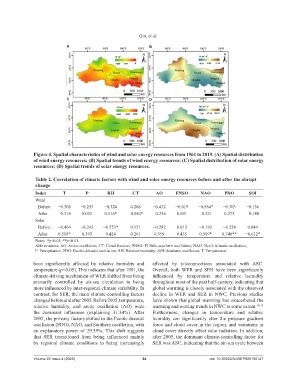
                Figure 4. Spatial characteristics of wind and solar energy resources from 1961 to 2019. (A) Spatial distribution
                of wind energy resources; (B) Spatial trends of wind energy resources; (C) Spatial distribution of solar energy
                resources; (D) Spatial trends of solar energy resources.

                 Table 2. Correlation of climate factors with wind and solar energy resources before and after the abrupt
                 change
                 Index       T         P        RH         CT         AO      ENSO       NAO        PDO        SOI
                 Wind
                  Before   −0.306    −0.233    −0.324     0.208     −0.432    −0.019    −0.584*    −0.303    −0.156
                  After    −0.316    0.021     0.516*    −0.584*    −0.236     0.091     −0.221     0.273    −0.188
                 Solar
                  Before   −0.464    −0.243   −0.553*     0.121     −0.282     0.013     −0.193    −0.224     0.044
                  After    0.518*    0.393      0.424     0.261      0.359     0.455     0.589*    0.746**   −0.612*
                 Notes: *p<0.05; **p<0.01.
                 Abbreviations: AO: Arctic oscillation; CT: Cloud fraction; ENSO: El Niño-southern oscillation; NAO: North Atlantic oscillation;
                 P: Precipitation; PDO: Pacific decadal oscillation; RH: Relative humidity; SOI: Southern oscillation; T: Temperature.

                been  significantly  affected  by  relative  humidity  and   affected  by  teleconnections  associated  with  ASC.
                temperature (p<0.05). This indicates that after 1991, the   Overall,  both  WER  and  SER  have  been  significantly
                climate-driving mechanism of WER shifted from being   influenced  by  temperature  and  relative  humidity
                primarily  controlled  by air-sea circulation  to being   throughout most of the past half-century, indicating that
                more influenced by inter-regional climate variability. In   global warming is closely associated with the observed
                contrast, for SER, the main climate-controlling factors   decline  in  WER and SER in NWC. Previous studies
                changed before and after 2005. Before 2005, temperature,   have  shown that global  warming  has exacerbated  the

                relative  humidity, and arctic  oscillation  (AO) were   warming and wetting trends in NWC to some extent. 10-13
                the  dominant  influences  (explaining  31.34%).  After   Furthermore, changes in temperature  and relative
                2005, the primary factors shifted to the Pacific decadal   humidity  can  significantly  alter  the  pressure  gradient
                oscillation (PDO), NAO, and Southern oscillation, with   force and cloud cover in the region, and variations in
                an explanatory power of 29.59%. This shift suggests   cloud cover directly affect solar radiation. In addition,
                that  SER  transitioned  from  being  influenced  mainly   after 2005, the dominant climate-controlling factor for
                by regional climate  conditions to being increasingly   SER was ASC, indicating that the air-sea cycle between


                Volume 22 Issue 4 (2025)                        34                           doi: 10.36922/AJWEP025190147

