


Page 55 - AJWEP-22-4
P. 55
Impact of cyclones on rice farming

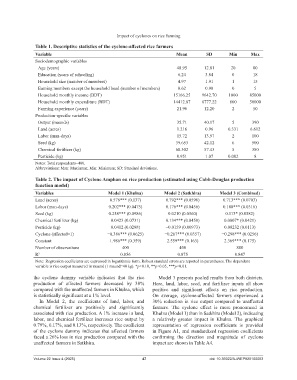
                 Table 1. Descriptive statistics of the cyclone‑affected rice farmers
                 Variable                                                      Mean         SD        Min      Max
                 Sociodemographic variables
                  Age (years)                                                  48.95       12.81       20       80
                  Education (years of schooling)                               6.24        3.84        0        18
                  Household size (number of members)                           4.97        1.91        1        15
                  Earning members except the household head (number of members)  0.62      0.90        0         5
                  Household monthly income (BDT)                             15166.25     9642.70     1000     85000
                  Household monthly expenditure (BDT)                        14412.87     6777.22     600      50000
                  Farming experience (years)                                   21.96       12.20       2        50
                 Production-specific variables
                  Output (maunds)                                              35.71       40.17       5        390
                  Land (acres)                                                 1.216       0.96      0.331     6.612
                  Labor (man-days)                                             15.72       13.97       2        100
                  Seed (kg)                                                   39.653       42.12       6        500
                  Chemical fertilizer (kg)                                    68.302       57.43       5        380
                  Pesticide (kg)                                               0.951       1.07      0.002       8
                 Notes: Total respondents=400.
                 Abbreviations: Max: Maximum; Min: Minimum; SD: Standard deviations.

                 Table 2. The impact of Cyclone Amphan on rice production (estimated using Cobb‑Douglas production
                 function model)
                 Variables                       Model 1 (Khulna)        Model 2 (Satkhira)       Model 3 (Combined)
                 Land (acres)                    0.576*** (0.137)         0.792*** (0.0596)        0.713*** (0.0703)
                 Labor (man-days)                0.202*** (0.0475)        0.176*** (0.0456)        0.188*** (0.0316)
                 Seed (kg)                       0.258*** (0.0986)         0.0210 (0.0560)          0.113* (0.0582)
                 Chemical fertilizer (kg)         0.0423 (0.0731)         0.134*** (0.0459)         0.0807* (0.0421)
                 Pesticide (kg)                   0.0412 (0.0298)         −0.0159 (0.00973)         0.00232 (0.0113)
                 Cyclone (affected=1)           −0.386*** (0.0625)       −0.267*** (0.0357)        −0.298*** (0.0256)
                 Constant                        1.986*** (0.359)          2.559*** (0.163)         2.369*** (0.175)
                 Number of observations                400                      400                      800
                 R 2                                  0.856                    0.875                    0.847
                 Note: Regression coefficients are expressed in logarithmic form. Robust standard errors are reported in parentheses. The dependent
                 variable is rice output measured in maund (1 maund=40 kg). *p<0.10, **p<0.05, ***p<0.01.

                the cyclone dummy variable indicates that the rice     Model 3 presents pooled results from both districts.
                production  of  affected  farmers  decreased  by  38%   Here, land, labor, seed, and fertilizer  inputs all show
                compared with the unaffected farmers in Khulna, which   positive  and  significant  effects  on  rice  production.
                is statistically significant at a 1% level.         On  average,  cyclone-affected  farmers  experienced  a
                  In  Model  2,  the  coefficients  of  land,  labor,  and   30%  reduction  in  rice  output  compared  to  unaffected
                chemical  fertilizer  are  positively  and  significantly   farmers.  The  cyclone  effect  is  more  pronounced  in
                associated with rice production. A 1% increase in land,   Khulna (Model 1) than in Satkhira (Model 2), indicating
                labor, and chemical fertilizer increases rice output by   a relatively  greater  impact  in Khulna.  The  graphical
                0.79%, 0.17%, and 0.13%, respectively. The coefficient   representation  of  regression  coefficients  is  provided
                of the cyclone dummy indicates that affected farmers   in Figure A1, and standardized regression coefficients
                faced a 26% loss in rice production compared with the   confirming  the  direction  and  magnitude  of  cyclone
                unaffected farmers in Satkhira.                     impact are shown in Table A4.


                Volume 22 Issue 4 (2025)                        47                           doi: 10.36922/AJWEP025100063

