


Page 58 - AJWEP-22-4
P. 58
Basu

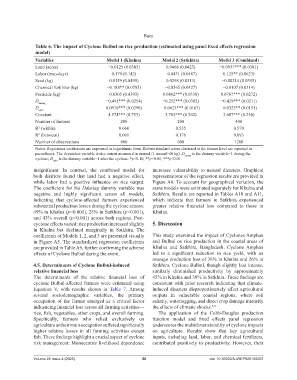
                 Table 6. The impact of Cyclone Bulbul on rice production (estimated using panel fixed effects regression
                 model)

                 Variables                      Model 1 (Khulna)         Model 2 (Satkhira)      Model 3 (Combined)
                 Land (acres)                    −0.0125 (0.0383)         0.0468 (0.0423)         −0.0937*** (0.0301)
                 Labor (man-days)                 0.179 (0.142)           −0.0431 (0.0487)         0.125** (0.0623)
                 Seed (kg)                       0.0159 (0.0495)          0.0298 (0.0513)          −0.00214 (0.0355)
                 Chemical fertilizer (kg)       −0.188** (0.0785)         −0.0565 (0.0427)         −0.0107 (0.0314)
                 Pesticide (kg)                  0.0305 (0.0393)         0.0862*** (0.0330)       0.0767*** (0.0272)
                 D during                       −0.491*** (0.0254)       −0.252*** (0.0302)       −0.429*** (0.0211)
                 D after                        0.0910*** (0.0290)      −0.0623*** (0.0163)       −0.0323** (0.0151)
                 Constant                        4.574*** (0.753)         3.783*** (0.262)         3.687*** (0.250)
                 Number of farmers                    200                      200                       400
                 R  (within)                         0.660                    0.555                     0.570
                  2
                 R  (between)                        0.001                    0.176                     0.093
                  2
                 Number of observations               600                      600                      1200
                 Notes: Regression coefficients are expressed in logarithmic form. Robust standard errors clustered at the farmer level are reported in
                 parentheses. The dependent variable is rice output measured in maund (1 maund=40 kg). D during  is the dummy variable=1 during the
                 cyclone; D   is the dummy variable=1 after the cyclone. *p<0.10, **p<0.05, ***p<0.01.
                        after
                insignificant.  In  contrast,  the  combined  model  for   increases vulnerability  to natural disasters.  Graphical
                both  districts  found  that  land  had  a  negative  effect,   representations of the regression results are provided in
                while  labor  had  a  positive  influence  on  rice  output.   Figure A6. To account for geographical variation, the
                The  coefficient  for  the  Dduring dummy variable was   same models were estimated separately for Khulna and
                negative  and  highly  significant  across  all  models,   Satkhira. Results are reported in Tables A10 and A11,
                indicating  that  cyclone-affected  farmers  experienced   which indicate  that farmers in Satkhira experienced
                substantial production losses during the cyclone season:   greater  relative  financial  loss  compared  to  those  in
                49% in Khulna (p<0.001), 25% in Satkhira (p<0.001),   Khulna.
                and 43% overall (p<0.001) across both regions. Post-
                cyclone effects varied: rice production increased slightly   5. Discussion
                in  Khulna  but  declined  marginally  in  Satkhira.  The
                coefficients of Models 1, 2, and 3 are presented visually   This study examined the impact of Cyclones Amphan
                in Figure A5. The standardized regression coefficients   and Bulbul on rice production in the coastal areas of
                are provided in Table A9, further confirming the adverse   Khulna  and  Satkhira,  Bangladesh.  Cyclone  Amphan
                effects of Cyclone Bulbul during the event.         led  to  a  significant  reduction  in  rice  yield,  with  an
                                                                    average production loss of 38% in Khulna and 26% in
                4.5. Determinants of Cyclone Bulbul‑induced         Satkhira. Cyclone Bulbul, though slightly less intense,
                relative financial loss                             similarly  diminished  productivity  by approximately
                The  determinants  of  the  relative  financial  loss  of   45% in Khulna and 38% in Satkhira. These findings are
                cyclone Bulbul-affected farmers were estimated using   consistent with prior research indicating that climate-
                Equation  V, with results shown  in  Table  7. Among   induced disasters disproportionately affect agricultural
                several sociodemographic variables, the primary     outputs in vulnerable coastal regions, where soil
                occupation  of the farmer  emerged as a critical  factor   salinity, waterlogging, and direct crop damage intensify
                influencing financial loss across all farming activities—  the effects of climatic shocks. 5,11
                rice, fish, vegetables, other crops, and overall farming.   The  application  of  the  Cobb-Douglas  production
                Specifically,  farmers  who  relied  exclusively  on   function  model  and  fixed  effects  panel  regression
                agriculture as their main occupation suffered significantly   underscores the multidimensionality of cyclone impacts
                higher relative losses in all farming activities  except   on agriculture. Results  show that  key  agricultural
                fish. These findings highlight a crucial aspect of cyclone   inputs, including land, labor, and chemical fertilizers,
                risk management: Monocentric livelihood dependence   contributed  positively  to productivity. However, their


                Volume 22 Issue 4 (2025)                        50                           doi: 10.36922/AJWEP025100063

