


Page 59 - AJWEP-22-4
P. 59
Impact of cyclones on rice farming

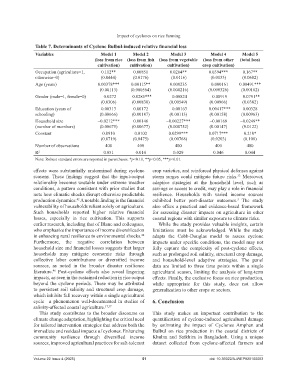
                 Table 7. Determinants of Cyclone Bulbul‑induced relative financial loss
                 Variables                   Model 1        Model 2         Model 3           Model 4       Model 5
                                           (loss from rice  (loss from fish  (loss from vegetable  (loss from other   (total loss)
                                            cultivation)  cultivation)     cultivation)   crop cultivation)
                 Occupation (agriculture=1,   0.112**       0.00851         0.0264**         0.0394***      0.167**
                 otherwise=0)                (0.0444)       (0.0176)         (0.0116)         (0.0133)      (0.0682)
                 Age (years)                0.00378***     0.00115**        0.000235         −0.000161    0.00491***
                                             (0.00113)     (0.000564)      (0.000216)        (0.000326)    (0.00182)
                 Gender (male=1, female=0)    −0.0272     −0.0285***        −0.00824         −0.00919      −0.0791**
                                             (0.0306)      (0.00830)        (0.00549)        (0.00966)      (0.0382)
                 Education (years of          0.00313       0.00172         −0.00163        −0.00417***     0.00328
                 schooling)                  (0.00666)     (0.00187)        (0.00113)        (0.00158)     (0.00963)
                 Household size             −0.0212***      0.00146       −0.00227***        −0.00169      −0.0249**
                 (number of members)         (0.00675)     (0.00677)       (0.000752)        (0.00147)      (0.0122)
                 Constant                     0.0910        0.0102         0.0299***         0.0717***      0.210*
                                             (0.0719)       (0.0475)        (0.00768)         (0.0203)      (0.108)
                 Number of observations        400            400             400               400           400
                 R 2                           0.051         0.014           0.029             0.046         0.044
                 Note: Robust standard errors are reported in parentheses. *p<0.10, **p<0.05, ***p<0.01.

                effects  were  substantially  undermined  during  cyclone   crop varieties, and reinforced physical defenses against
                seasons.  These  findings  suggest  that  the  input-output   storm  surges  could  mitigate  future  risks.   Moreover,
                                                                                                          33
                relationship becomes unstable under extreme weather   adaptive  strategies  at  the  household level,  such as
                conditions, a pattern consistent with prior studies that   savings or access to credit, may play a role in financial
                note how climatic shocks disrupt otherwise predictable   resilience.  Households with varied  income  sources
                production dynamics.  A notable finding is the financial   exhibited  better post-disaster outcomes.  The  study
                                                                                                         3
                                   42
                vulnerability of households reliant solely on agriculture.   also  offers  a  practical  and  evidence-based  framework
                Such  households  reported  higher  relative  financial   for assessing disaster impacts  on agriculture  in other
                losses, especially in rice  cultivation.  This supports   coastal regions with similar exposure to climate risks.
                earlier research, including that of Blanc and colleagues,   While the study provides valuable insights, certain
                who emphasize the importance of income diversification   limitations  must  be  acknowledged.  While  the  study
                in enhancing rural resilience to environmental shocks.    adapts  the  Cobb-Douglas  model  to  assess  cyclone
                                                               44
                Furthermore,  the  negative  correlation  between   impacts under specific conditions, the model may not
                household size and financial losses suggests that larger   fully  capture  the  complexity  of  post-cyclone  effects,
                households may mitigate  economic  risks through    such as prolonged soil salinity, structural crop damage,
                collective  labor  contributions  or  diversified  income   and household-level  adaptive strategies.  The panel
                sources, as noted in the broader disaster resilience   data  are limited to  three  time  points  within  a  single
                literature.   Post-cyclone  effects  also  reveal  lingering   agricultural season, limiting the analysis of long-term
                        46
                impacts, as seen in the sustained reduction in rice output   effects. Finally, the exclusive focus on rice production,
                beyond the cyclone  periods. These may be attributed   while  appropriate  for this  study, does not  allow
                to persistent  soil salinity  and structural  crop damage,   generalization to other crops or sectors.
                which inhibits full recovery within a single agricultural
                cycle—a  phenomenon well-documented  in studies of   6. Conclusion
                salinity-affected coastal agriculture. 17,37
                  This study contributes to the broader discourse on   This  study  makes  an  important  contribution  to  the
                climate change adaptation, highlighting the critical need   quantification of cyclone-induced agricultural damage
                for tailored intervention strategies that address both the   by  estimating  the  impact  of  Cyclones  Amphan  and
                immediate and residual impacts of cyclones. Enhancing   Bulbul on rice production in the coastal districts of
                community  resilience  through  diversified  income   Khulna  and  Satkhira  in  Bangladesh.  Using a  unique
                sources, improved agricultural practices for salt-tolerant   dataset  collected  from  cyclone-affected  farmers  and


                Volume 22 Issue 4 (2025)                        51                           doi: 10.36922/AJWEP025100063

