


Page 56 - AJWEP-22-4
P. 56
Basu

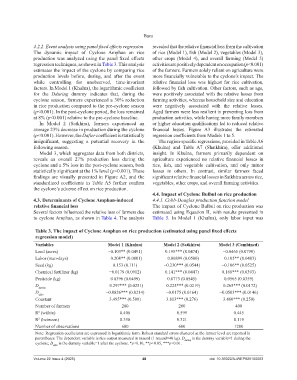
                4.2.2. Event analysis using panel fixed effects regression  revealed that the relative financial loss from the cultivation
                The  dynamic  impact  of  Cyclone  Amphan  on  rice   of rice (Model 1), fish (Model 2), vegetables (Model 3),
                production was analyzed using the panel fixed effects   other crops (Model 4), and overall farming (Model 5)
                regression techniques, as shown in Table 3. This analysis   activities are positively dependent on occupation (p<0.001)
                estimates the impact of the cyclone by comparing rice   of the farmers. Farmers solely reliant on agriculture were
                production levels before, during, and after the event   more financially vulnerable to the cyclone’s impact. The
                while  controlling  for unobserved,  time-invariant   relative  financial  loss  was  highest  for  rice  cultivation,
                factors. In Model 1 (Khulna), the logarithmic coefficient   followed by fish cultivation. Other factors, such as age,
                for the  Dduring dummy indicates  that, during the   were positively associated with the relative losses from
                cyclone season, farmers experienced a 30% reduction   farming activities, whereas household size and education
                in rice production compared to the pre-cyclone season   were negatively associated with the relative losses.
                (p<0.001). In the post-cyclone period, the loss remained   Aged farmers were less resilient in preventing loss from
                at 8% (p<0.001) relative to the pre-cyclone baseline.  production activities, while having more family members
                  In  Model  2  (Satkhira),  farmers  experienced  an   or higher education qualifications led to reduced relative
                average 23% decrease in production during the cyclone   financial  losses.  Figure  A3 illustrates the estimated
                (p<0.001). However, the Dafter coefficient is statistically   regression coefficients from Models 1 to 5.
                insignificant,  suggesting  a  potential  recovery  in  the   The region-specific regressions, provided in Table A6
                following season.                                   (Khulna) and  Table  A7  (Shatkhira),  offer  additional
                  Model 3, which aggregates data from both districts,   insight. In Khulna, farmers primarily dependent on
                reveals  an  overall  27%  production  loss  during  the   agriculture  experienced  no  relative  financial  losses  in
                cyclone and a 5% loss in the post-cyclone season, both   rice,  fish,  and  vegetable cultivation, and only minor
                statistically significant at the 1% level (p<0.001). These   losses in others. In contrast, similar farmers faced
                findings  are  visually  presented  in  Figure A2, and the   significant relative financial losses in Satkhira across rice,
                standardized  coefficients  in  Table A5  further  confirm   vegetables, other crops, and overall farming activities.
                the cyclone’s adverse effect on rice production.
                                                                    4.4. Impact of Cyclone Bulbul on rice production
                4.3. Determinants of Cyclone Amphan‑induced         4.4.1. Cobb-Douglas production function model
                relative financial loss                             The impact of Cyclone Bulbul on rice production was
                Several factors influenced the relative loss of farmers due   estimated using Equation II, with results presented in
                to cyclone Amphan, as shown in Table 4. The analysis   Table  5. In Model 1 (Khulna), only labor  input  was

                 Table 3. The impact of Cyclone Amphan on rice production (estimated using panel fixed effects
                 regression model)
                 Variables                       Model 1 (Khulna)        Model 2 (Satkhira)      Model 3 (Combined)
                 Land (acres)                    −0.103** (0.0491)        0.195*** (0.0474)        −0.0465 (0.0790)
                 Labor (man-days)                −0.208** (0.0801)        −0.00899 (0.0500)        −0.105** (0.0483)
                 Seed (kg)                         0.153 (0.111)         −0.230*** (0.0544)        −0.106** (0.0525)
                 Chemical fertilizer (kg)        −0.0179 (0.0912)         0.141*** (0.0447)        0.168*** (0.0393)
                 Pesticide (kg)                   0.0396 (0.0499)          0.0773 (0.0545)          0.0565 (0.0359)
                 D during                       −0.297*** (0.0251)       −0.225*** (0.0219)       −0.265*** (0.0172)
                 D after                        −0.0826*** (0.0214)       −0.0175 (0.0164)        −0.0503*** (0.0146)
                 Constant                        3.495*** (0.508)         3.813*** (0.276)         3.460*** (0.250)
                 Number of farmers                     200                      200                      400
                 R  (within)                          0.406                    0.599                    0.445
                  2
                 R  (between)                         0.350                    0.321                    0.119
                  2
                 Number of observations                600                      600                     1200
                 Note: Regression coefficients are expressed in logarithmic form. Robust standard errors clustered at the farmer level are reported in
                 parentheses. The dependent variable is rice output measured in maund (1 maund=40 kg). D during  is the dummy variable=1 during the
                 cyclone; D after  is the dummy variable=1 after the cyclone. *p<0.10, **p<0.05, ***p<0.01.


                Volume 22 Issue 4 (2025)                        48                           doi: 10.36922/AJWEP025100063

