


Page 57 - AJWEP-22-4
P. 57
Impact of cyclones on rice farming

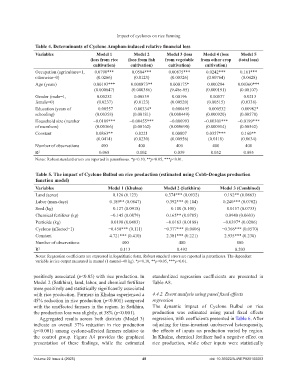
                 Table 4. Determinants of Cyclone Amphan‑induced relative financial loss
                 Variables                 Model 1          Model 2       Model 3 (loss   Model 4 (loss    Model 5
                                         (loss from rice   (loss from fish   from vegetable   from other crop   (total loss)
                                          cultivation)    cultivation)     cultivation)    cultivation)
                 Occupation (agriculture=1,   0.0790***    0.0504***       0.00875***       0.0242***      0.161***
                 otherwise=0)               (0.0266)        (0.0123)        (0.00326)       (0.00764)       (0.0428)
                 Age (years)              0.00193***       0.000873**       0.000175*       0.000294      0.00360***
                                           (0.000647)      (0.000386)       (9.48e-05)      (0.000191)     (0.00107)
                 Gender (male=1,            0.00232         0.00539          0.00196        −0.00537       −0.0213
                 female=0)                  (0.0237)        (0.0123)        (0.00520)       (0.00515)      (0.0338)
                 Education (years of       −0.00557        −0.00334*        −0.000495       −0.000532     −0.00982*
                 schooling)                (0.00358)       (0.00181)        (0.000449)      (0.000920)     (0.00570)
                 Household size (number   −0.0109***      −0.00455***       −0.000993      −0.00301***    −0.0199***
                 of members)               (0.00366)       (0.00162)        (0.000690)      (0.000914)     (0.00562)
                 Constant                  0.0863**          0.0221          0.00807        0.0357***      0.160**
                                            (0.0414)        (0.0230)        (0.00956)        (0.0118)      (0.0634)
                 Number of observations      400              400              400             400           400
                 R 2                         0.068           0.102            0.039           0.052         0.095
                 Notes: Robust standard errors are reported in parentheses. *p<0.10, **p<0.05, ***p<0.01.


                 Table 5. The impact of Cyclone Bulbul on rice production (estimated using Cobb‑Douglas production
                 function model)

                 Variables                       Model 1 (Khulna)        Model 2 (Satkhira)       Model 3 (Combined)
                 Land (acres)                      0.126 (0.123)          0.374*** (0.0932)         0.192** (0.0863)
                 Labor (man-days)                0.189** (0.0847)         0.392*** (0.104)         0.240*** (0.0702)
                 Seed (kg)                        −0.127 (0.0918)          −0.100 (0.108)           −0.0157 (0.0733)
                 Chemical fertilizer (kg)         −0.145 (0.0879)         0.165** (0.0785)          0.0940 (0.0603)
                 Pesticide (kg)                   0.0190 (0.0483)         −0.0163 (0.0188)         −0.0397* (0.0206)
                 Cyclone (affected=1)            −0.450*** (0.111)       −0.377*** (0.0606)        −0.366*** (0.0570)
                 Constant                        4.721*** (0.410)         2.381*** (0.221)          2.935*** (0.230)
                 Number of observations                400                      400                      800
                 R 2                                  0.113                    0.492                    0.203
                 Notes: Regression coefficients are expressed in logarithmic form. Robust standard errors are reported in parentheses. The dependent
                 variable is rice output measured in maund (1 maund=40 kg). *p<0.10, **p<0.05, ***p<0.01.


                positively associated (p<0.05) with rice production. In   standardized  regression  coefficients  are  presented  in
                Model 2 (Satkhira), land, labor, and chemical fertilizer   Table A8.
                were positively and statistically significantly associated
                with rice production. Farmers in Khulna experienced a   4.4.2. Event analysis using panel fixed effects
                45% reduction in rice production (p<0.001) compared   regression
                with the unaffected farmers in the region. In Satkhira,   The  dynamic  impact  of  Cyclone  Bulbul  on  rice
                the production loss was slightly, at 38% (p<0.001).  production  was  estimated  using  panel  fixed  effects
                  Aggregated  results  across both  districts  (Model  3)   regression, with coefficients presented in Table 6. After
                indicate  an  overall  37%  reduction  in  rice  production   adjusting for time-invariant unobserved heterogeneity,
                (p<0.001)  among  cyclone-affected  farmers  relative  to   the  effects  of  inputs  on  production  varied  by  region.
                the control group.  Figure  A4 provides the  graphical   In Khulna, chemical fertilizer had a negative effect on
                presentation  of  these  findings,  while  the  estimated   rice  production,  while  other  inputs  were  statistically


                Volume 22 Issue 4 (2025)                        49                           doi: 10.36922/AJWEP025100063

