


Page 74 - AJWEP-22-4
P. 74
Tanko, et al.

                their partitions with aldehydes, hydroxyl, amines ketones,
                carboxyl organizations and phosphates accountable for
                metallic cation adsorption and chelation.  Unfortunately,
                                                  20
                the usage of these traditional approaches is limited because
                of  disadvantages  such  as  low  selectivity,  incomplete
                elimination, excessive electricity consumption, high cost,
                or generation of excessive poisonous waste. Therefore,
                this  calls  for  safe,  low-cost,  and  potent  techniques  for
                extracting heavy metals from polluted water.
                  Biosorption is the use of dried organisms as
                adsorbents.  There are numerous methods for metallic
                          20
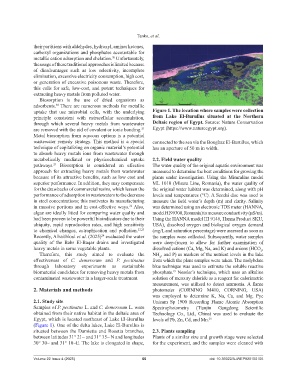
                uptake  that  use  microbial  cells,  with  the  underlying   Figure 1. The location where samples were collection
                principle  consistent  with  extracellular  accumulation,   from Lake El-Burullus situated at the Northern
                through  which  several  heavy  metals  from  wastewater   Deltaic region of Egypt. Source: Nature Conservation
                are removed with the aid of covalent or ionic bonding.    Egypt (https://www.natureegypt.org).
                                                               21
                Metal biosorption from aqueous options is a potential
                wastewater  remedy  strategy. This  method  is  a  special   connected to the sea via the Boughaz El-Burullus, which
                technique of capitalizing on organic material’s potential   has an aperture of 50 m in width.
                to absorb heavy metals ions from wastewater through
                metabolically mediated or physicochemical uptake    2.2. Field water quality
                pathways.   Biosorption  is  considered  an  effective   The water quality of the original aquatic environment was
                         21
                approach for extracting heavy metals from wastewater   measured to determine the best conditions for growing the
                because of its attractive benefits, such as low cost and   plants under investigation. Using the Misuraline model
                superior performance. In addition, they may compensate   ML 1010 (Misura Line, Romania), the water quality of
                for the drawbacks of commercial resins, which lessen the   the original water habitat was determined, along with pH
                performance of adsorption in wastewaters to the decrease   levels and temperatures (°C). A Secchi disc was used to
                in steel concentrations; this motivates its manufacturing   measure the field water’s depth (m) and clarity. Salinity
                in massive portions and in cost-effective ways.  Also,   was determined using an electronic TDS meter (HANNA,
                                                          22
                algae are ideally fitted for comparing water quality and   model HI99300, Romania) to measure conductivity (μS/m).
                had been proven to be powerful bioindicators due to their   Using the HANNA model HI 9146, Hanna Product SKU,
                ubiquity, rapid reproduction rates, and high sensitivity   USA), dissolved oxygen and biological oxygen demand
                to  chemical  changes,  eutrophication  and  pollution. 22,23    (mg/L and saturation percentage) were assessed as soon as
                Recently, Alhaithloul et al. (2025)  evaluated the water   the samples were collected. Subsequently, water samples
                                              24
                quality of the Bahr El-Baqar drains and investigated   were  deep-frozen  to  allow  for  further  examination  of
                heavy metals in some vegetable plants.              dissolved cations (Ca, Mg, Na, and K) and anions (HCO ,
                                                                                                                    3
                  Therefore,  this study aimed  to evaluate  the    NH , and P) as markers of the nutrient levels in the lake
                                                                       4
                effectiveness  of  C. demerssum and  P. pectinatus   from which the plant samples were taken. The molybdate
                through  laboratory  experiments  as  sustainable   blue technique was used to estimate the soluble reactive
                biomaterial candidates for removing heavy metals from   phosphate.  Nessler’s technique, which uses an alkaline
                                                                             25
                contaminated wastewater in a larger-scale treatment.  solution of mercury chloride as a reagent for calorimetric
                                                                    measurement,  was  utilized  to  detect  ammonia. A  flame
                2. Materials and methods                            photometer  (CORNING  M410,  CORNING,  USA)
                                                                    was  employed  to  determine  K,  Na,  Ca,  and  Mg.  Pye
                2.1. Study site                                     Unicam  Sp  1900  Recording  Flame Atomic Absorption
                Samples of P. pectinatus L. and C. demerssum L. were   Spectrophotometry   (Tianjin   Gangdong   Scientific
                obtained from their native habitat in the deltaic area of   Technology  Co.,  Ltd.,  China)  was  used  to  evaluate  the
                Egypt, which is located northeast of Lake El-Burullus   levels of Pb, Zn, Cd, and Mn. 26
                (Figure 1). One of the delta lakes, Lake El-Burullus is
                situated  between  the  Damietta  and  Rosetta  branches,   2.3. Plants sampling
                between latitudes 31° 21~ and 31° 35~ N and longitudes   Plants of a similar size and growth stage were selected
                30° 30~ and 31° 10~E. The lake is elongated in shape,   for the experiment, and the samples were cleaned with


                Volume 22 Issue 4 (2025)                        66                           doi: 10.36922/AJWEP025150105

