


Page 76 - AJWEP-22-4
P. 76
Tanko, et al.

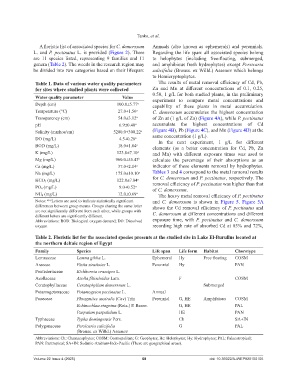
                  A floristic list of associated species for C. demerssum   Annuals  (also  known  as  ephemerals)  and  perennials.
                L. and P. pectinatus L. is provided (Figure 2). There   Regarding the life span: all associated species belong
                are  11 species  listed,  representing  9 families  and  11   to  helophytes  (including  free-floating,  submerged,
                genera (Table 2). The weeds in the research region may   and amphibious fresh hydrophytes) except Persicaria
                be divided into two categories based on their lifespan:   salicifolia (Brouss. ex Willd.) Assenov which belongs
                                                                    to Hemicryptophytes.
                 Table 1. Data of various water quality parameters     The results of metal removal efficiency of Cd, Pb,
                 for sites where studied plants were collected      Zn  and  Mn  at  different  concentrations  of  0.1,  0.25,
                 Water quality parameter               Value        0.50, 1 g/L for both studied plants, in the preliminary
                                                                    experiment  to  compare  metal  concentrations  and
                 Depth (cm)                         100.0±5.77 a    capability  of these plants in metal  accumulation.
                 Temperature (°C)                    27.0±1.56 a    C. demerssum  accumulates  the highest concentration
                 Transparency (cm)                   54.0±3.12 a    of Zn at (1 g/L of Zn) (Figure 4A), while P. pectinatus
                 pH                                  6.9±0.40 a     accumulate  the highest concentrations  of Cd
                 Salinity (mmhos/cm)               5200.0±300.22 c  (Figure 4B), Pb (Figure 4C), and Mn (Figure 4D) at the
                 DO (mg/L)                           4.5±0.26 a     same concentration (1 g/L).
                                                                       In  the  next  experiment,  1  g/L  for  different
                 BOD (mg/L)                          18.0±1.04 a    elements  (as  a  better  concentration  for  Cd,  Pb,  Zn
                 K (mg/L)                           123.0±7.10 a    and  Mn)  with  different  exposure  times  was  used  to
                 Mg (mg/L)                          960.0±55.43 b   calculate the  percentage of their absorptions as an
                 Ca (mg/L)                           37.0±2.14 a    indicator of these elements removal by hydrophytes.
                 Na (mg/L)                          175.0±10.10 a   Tables 3 and 4 correspond to the metal removal results
                 HCO 3 (mg/L)                       122.0±7.04 a    for C. demerssum and P. pectinatus, respectively. The
                 PO 4 (mg/L)                         9.0±0.52 a     removal efficiency of P. pectinatus was higher than that
                                                                    of C. demerssum.
                 NH 4 (mg/L)                         12.0±0.69 a       The heavy metal removal efficiency of P. pectinatus
                 Notes:  a,b,c Letters are used to indicate statistically significant   and  C. demerssum  is  shown  in  Figure  5.  Figure  5A
                 differences between group means. Groups sharing the same letter   shows the Cd removal efficiency of P. pectinatus and
                 are not significantly different from each other, while groups with
                 different letters are significantly different.     C. demerssum at different concentrations and different
                 Abbreviations: BOD: Biological oxygen demand; DO: Dissolved   exposure  time,  with  P. pectinatus and  C. demerssum
                 oxygen.                                            recording high rate of absorbed Cd at 85% and 72%,

                 Table 2. Floristic list for the associated species presents at the studied site in Lake El-Burullus located at
                 the northern deltaic region of Egypt
                 Family            Species                          Life span   Life form  Habitat      Chorotype
                 Lemnaceae         Lemna gibba L.                   Ephemeral   Hy         Free floating  COSM
                 Araceae           Pistia stratiotes L.             Perennial   Hy                      PAN
                 Pontederiaceae    Eichhornia crassipes L.
                 Azollaceae        Azolla filiculoides Lam.                     F                       COSM
                 Ceratophyllaceae  Ceratophyllum demerssum L.                              Submerged
                 Potamogetonaceae  Potamogeton pectinatus L.        Annual
                 Poaeceae          Phragmites australis (Cav) Trin  Perennial   G, HE      Amphibious   COSM
                                   Echinochloa stagnina (Retz.) P. Beanv.       G, HE                   PAL
                                   Paspalum paspalidum L.                       HE                      PAN
                 Typhaceae         Typha domingensis Pers.                      Ch                      SA+IN
                 Polygonaceae      Persicaria salicifolia                       G                       PAL
                                   (Brouss. ex Willd.) Assenov
                 Abbreviations: Ch: Chamaeophytes; COSM: Cosmopolitan; G: Geophytes; He: Helophytes; Hy: Hydrophytes; PAL: Palaeotropical;
                 PAN: Pantropical; SA+IN: Sudanic-Arabian+Indo-Pacific (These are geographical areas).


                Volume 22 Issue 4 (2025)                        68                           doi: 10.36922/AJWEP025150105

