


Page 79 - AJWEP-22-4
P. 79
Hydrophytes for removing heavy metals

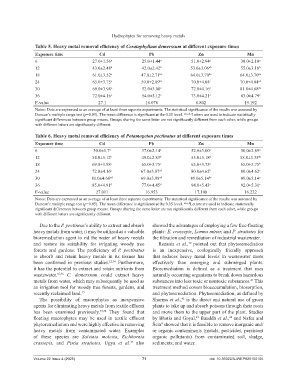
                 Table 5. Heavy metal removal efficiency of Ceratophyllum demerssum at different exposure times
                 Exposure time               Cd                    Pb                   Zn                    Mn
                 6                        27.0±1.56 a           25.0±1.44 a          51.0±2.94 a           38.0±2.19 a
                 12                       43.0±2.48 b          42.0±2.42 b           53.0±3.06 ab          55.0±3.18 b
                 18                       61.0±3.52 c          47.0±2.71 bc          64.0±3.70 bc          64.0±3.70 bc
                 24                       65.0±3.75 c          50.0±2.89 bc          70.0±4.04 c           70.0±4.04 cd
                 30                       69.0±3.98 c           52.0±3.00 c          72.0±4.16 c           81.0±4.68 de
                 36                       72.0±4.16 c           54.0±3.12 c          73.0±4.21 c           83.0±4.79 e
                 F-value                    27.1                 16.078                6.802                 19.192
                 Notes: Data are expressed as an average of at least three separate experiments. The statistical significance of the results was assessed by
                 Duncan’s multiple range test (p=0.05). The mean difference is significant at the 0.05 level.  a,b,c,d,e Letters are used to indicate statistically
                 significant differences between group means. Groups sharing the same letter are not significantly different from each other, while groups
                 with different letters are significantly different.

                 Table 6. Heavy metal removal efficiency of Potamogeton pectinatus at different exposure times
                 Exposure time               Cd                    Pb                   Zn                    Mn
                 6                        30.0±1.7 a           37.0±2.14 a           52.0±3.00 a           50.0±2.89 a
                 12                       54.0±3.12 b          49.0±2.83 b           55.0±3.18 a           58.0±3.35 ab
                 18                       69.0±3.98 c          65.0±3.75 c           65.0±3.75 a           65.0±3.75 b
                 24                       72.0±4.16 c          67.0±3.87 cd          80.0±4.62 b           80.0±4.62 c
                 30                      81.0±4.68 cd          69.0±3.98 cd          89.0±5.14 bc          89.0±5.14 c
                 36                       85.0±4.91 d          77.0±4.45 d           94.0±5.43 c           92.0±5.31 c
                 F-value                   27.011                16.953                17.108                16.222
                 Notes: Data are expressed as an average of at least three separate experiments. The statistical significance of the results was assessed by
                 Duncan’s multiple range test (p=0.05). The mean difference is significant at the 0.05 level.  a,b,c,d Letters are used to indicate statistically
                 significant differences between group means. Groups sharing the same letter are not significantly different from each other, while groups
                 with different letters are significantly different.

                  Due to the P. pectineus’s ability to extract and absorb   showed the advantages of employing a few free-floating
                heavy metals from water, it may be utilized as a valuable   plants: E. crassepis, Lemna minor, and P. stratiotes for
                bioremediation agent to rid the water of heavy metals   the filtration and remediation of industrial wastewater.
                and  restore  its  suitability  for  irrigating  woody  tree   Rezania et al.,  pointed out that phytoremediation
                                                                                    40
                forests  and  gardens.  The  proficiency  of  P. pectinatus   is  an  inexpensive,  ecologically  friendly  approach
                to absorb and retain heavy metals  in its tissues has   that  reduces  heavy  metal  levels  in  wastewater  more
                been  confirmed  in  previous  studies. 12,34  Furthermore,   effectively  than  emerging  and  submerged  plants.
                it has the potential to extract and retain nutrients from   Bioremediation  is  defined  as  a  treatment  that  uses
                wastewater. 35,36   C. demerssum  could  extract  heavy   naturally occurring organisms to break down hazardous
                metals from water, which may subsequently be used as   substances into less toxic or nontoxic substances.  This
                                                                                                               41
                an irrigation tool for woody tree forests, gardens, and   treatment method covers bioaccumulation, biosorption,
                recently reclaimed land. 17                         and phytoremediation. Phytoremediation, as defined by
                  The  possibility  of  macrophytes  as  inexpensive   Sharma et al.,  is the direct and natural use of green
                                                                                 42
                agents for eliminating heavy metals from textile effluent   plants to take up and absorb poisons through their roots
                has  been  examined  previously. 37,38   They found that   and move them to the upper part of the plant. Studies
                floating  macrophytes  may  be  used  in  textile  effluent   by Bhatia and Goyal,  Bauddh et al.,  and Nafea and
                                                                                       43
                                                                                                      44
                phytoremediation and were highly effective in removing   Šera  showed that it is feasible to remove inorganic and/
                                                                        8
                heavy  metals  from  contaminated  water.  Examples   or organic contaminants (metals, pesticides, persistent
                of these  species  are  Salvinia  molesta, Eichhornia   organic pollutants) from contaminated  soil, sludge,
                crassepis, and  Pistia  stratiotes. Ugya  et al.  also   sediments, and water.
                                                          39


                Volume 22 Issue 4 (2025)                        71                           doi: 10.36922/AJWEP025150105

