


Page 75 - AJWEP-22-4
P. 75
Hydrophytes for removing heavy metals

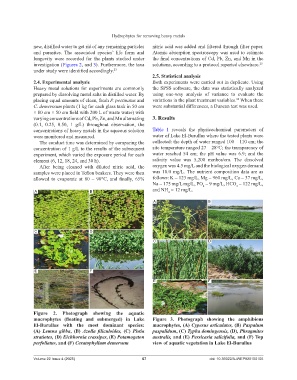
                new, distilled water to get rid of any remaining particles   nitric acid was added and filtered through filter paper.
                and parasites.  The associated species’ life form and   Atomic absorption spectroscopy was used to estimate
                longevity  were  recorded  for  the  plants  studied  under   the final concentrations of Cd, Pb, Zn, and Mn in the
                investigation (Figures 2, and 3). Furthermore, the taxa   solutions, according to a protocol reported elsewhere. 25
                under study were identified accordingly. 27
                                                                    2.5. Statistical analysis
                2.4. Experimental analysis                          Both experiments were carried out in duplicate. Using
                Heavy metal solutions for experiments are commonly   the SPSS software, the data was statistically analyzed
                prepared by dissolving metal salts in distilled water. By   using  one-way  analysis  of  variance  to  evaluate  the
                placing equal amounts of clean, fresh P. pectinatus and   variations in the plant treatment variables.  When there
                                                                                                         28
                C. demerssum plants (1 kg for each glass tank in 50 cm   were substantial differences, a Duncan test was used.
                × 80 cm × 50 cm field with 200 L of waste water) with
                varying concentrations of Cd, Pb, Zn, and Mn alternating   3. Results
                (0.1, 0.25, 0.50, 1  g/L) throughout observation,  the
                concentrations of heavy metals in the aqueous solution   Table  1 reveals  the  physicochemical  parameters  of
                were monitored and measured.                        water of Lake El-Burullus where the tested plants were
                  The conduct time was determined by comparing the   collected: the depth of water ranged 100 – 110 cm; the
                concentration of 1 g/L to the results of the subsequent   site temperature ranged 27 – 28°C; the transparency of
                experiment, which varied the exposure period for each   water reached 54 cm; the pH value was 6.9; and the
                element (6, 12, 18, 24, and 30 h).                  salinity  value  was  5,200  mmhos/cm.  The  dissolved
                  After  being  cleaned  with  diluted  nitric  acid,  the   oxygen was 4.5 mg/L and the biological oxygen demand
                samples were placed in Teflon beakers. They were then   was 18.0 mg/L. The nutrient composition data are as
                allowed  to  evaporate  at  80  –  90°C,  and  finally,  65%   follows: K = 123 mg/L, Mg = 960 mg/L, Ca = 37 mg/L,
                                                                    Na = 175 mg/L mg/L, PO  = 9 mg/L, HCO  = 122 mg/L,
                                                                                          4
                                                                                                         3
                A                        B                          and NH  = 12 mg/L.
                                                                           4
                                                                     A                       B


                C                        D
                                                                    C                        D


                E                        F
                                                                     E                       F


                Figure  2. Photograph showing the aquatic
                macrophytes  (floating  and  submerged)  in  Lake   Figure  3. Photograph showing the amphibious
                El-Burullus  with the  most dominant species:       macrophytes, (A) Cyperus articulates, (B) Paspalum
                (A)  Lemna gibba,  (B)  Azolla  filiculoides,  (C)  Pistia   paspalidum, (C) Typha domingensis, (D), Phragmites
                stratiotes, (D) Eichhornia crassipes, (E) Potamogeton   australis, and (E) Persicaria salicifolia, and (F) Top
                perfoliatus, and (F) Ceratophyllum demersum         view of aquatic vegetation in Lake El-Burullus


                Volume 22 Issue 4 (2025)                        67                           doi: 10.36922/AJWEP025150105

