


Page 78 - AJWEP-22-4
P. 78
Tanko, et al.

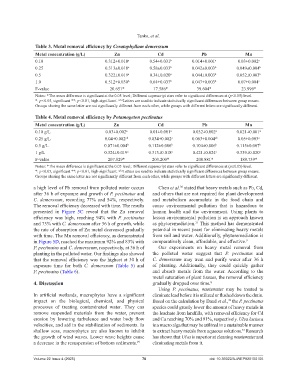
                 Table 3. Metal removal efficiency by Ceratophyllum demerssum
                 Metal concentration (g/L)         Zn                 Cd                  Pb                 Mn
                 0.10                          0.312±0.018 a       0.54±0.031 b       0.014±0.001 a       0.03±0.002 a
                 0.25                          0.313±0.018 a       0.58±0.033 b       0.042±0.003 b      0.049±0.004 b
                 0.5                           0.322±0.019 a       0.34±0.020 a       0.044±0.003 b      0.052±0.003 b
                 1.0                           0.512±0.030 b       0.64±0.037 b       0.047±0.003 b       0.07±0.004 c
                 F-value                         20.651*             17.586*            39.604*            23.999*
                 Notes: *The mean difference is significant at the 0.05 level; Different superscript stars refer to significant differences at (p≤0.05) level.
                 *: p<0.05, significant **: p<0.01, high-significant.  a,b,c Letters are used to indicate statistically significant differences between group means.
                 Groups sharing the same letter are not significantly different from each other, while groups with different letters are significantly different.

                 Table 4. Metal removal efficiency by Potamogeton pectinatus
                 Metal concentration (g/L)         Zn                 Cd                  Pb                 Mn
                 0.10 g/L                      0.03±0.002 a        0.01±0.001 a       0.032±0.002 a      0.021±0.001 a
                 0.25 g/L                      0.04±0.002 ab      0.034±0.002 a       0.063±0.004 ab      0.05±0.003 a
                 0.5 g/L                       0.071±0.004 b      0.112±0.006 b       0.104±0.006 b      0.115±0.007 b
                 1 g/L                         0.324±0.019 c      0.313±0.018 c       0.421±0.024 c      0.339±0.020 c
                 F-value                         207.829*           203.200*           200.881*            189.739*
                 Notes: *The mean difference is significant at the 0.05 level; Different superscript stars refer to significant differences at (p≤0.05) level.
                 *: p<0.05, significant **: p<0.01, high-significant.  a,b,c Letters are used to indicate statistically significant differences between group means.
                 Groups sharing the same letter are not significantly different from each other, while groups with different letters are significantly different.
                a high level of Pb removal from polluted water occurs   Chen et al.  stated that heavy metals such as Pb, Cd,
                                                                                30
                after 36 h of exposure and growth of P. pectinatus and   and others that are not required for plant development
                C. demerssum, recording 77% and 54%, respectively.   and metabolism accumulate in the food chain and
                The removal efficiency decreased with time. The results   cause environmental pollution that is hazardous to
                presented in  Figure  5C reveal  that the Zn removal   human health and the environment. Using plants to
                efficiency was high, reaching 94% with P. pectinatus   lessen environmental pollution is an approach known
                and 73% with C. demerssum after 36 h of growth, while   as phytoremediation.  This method has demonstrated
                                                                                       31
                the rate of absorption of Zn metal decreased gradually   potential in recent years for eliminating heavy metals
                with time. The Mn removal efficiency, as demonstrated   from soil and water. Additionally, phytoremediation is
                in Figure 5D, reached the maximum 92% and 83% with   comparatively clean, affordable, and effective. 9
                P. pectinatus and C. demerssum, respectively, at 36 h of   Our  experiments  on  heavy  metal  removal  from
                planting in the polluted water. Our findings also showed   the  polluted  water  suggest  that  P.  pectinatus  and
                that the removal efficiency was the highest at 30 h of   C. demerssum  may  treat  and  purify  water  after  36  h
                exposure  time  for  both  C. demerssum  (Table  5) and   of planting.  Additionally, they  could  quickly  gather
                P. pectinatus (Table 6).                            and  absorb  metals  from  the  water.  According  to  the
                                                                    metal saturation of plant tissues, the removal efficiency
                4. Discussion                                       gradually dropped over time. 8
                                                                       Using  P. pectinatus,  wastewater  may  be  treated  to
                In  artificial  wetlands,  macrophytes  have  a  significant   eliminate lead before it is utilized or flushed down the drain.
                impact  on the biological,  chemical,  and physical   Based on the calculation by Daud et al.,  the P. pectinatus
                                                                                                     32
                processes  of  treating  contaminated  water.  They  can   species could greatly lower the amount of heavy metals in
                remove  suspended  materials  from  the  water,  prevent   the leachate from landfills, with removal efficiency for Cd
                erosion  by  lowering  turbulence  and  water  body  flow   and Cu reaching 70% and 91%, respectively. Ulva lactuca
                velocities, and aid in the stabilization of sediments. In   is a macro alga that may be utilized in a sustainable manner
                shallow  seas,  macrophytes  are  also  known  to  inhibit   to extract heavy metals from aqueous solutions.  Research
                                                                                                            33
                the growth of wind waves. Lower wave heights cause   has shown that Ulva is superior at cleaning wastewater and
                a decrease in the resuspension of bottom sediments. 29  eliminating metals from it.


                Volume 22 Issue 4 (2025)                        70                           doi: 10.36922/AJWEP025150105

