


Page 127 - AJWEP-22-6
P. 127
Plantain waste for lab water cleanup

                The banana fruit, an agricultural commodity valued at   100-micron mesh to obtain uniform powdered material.
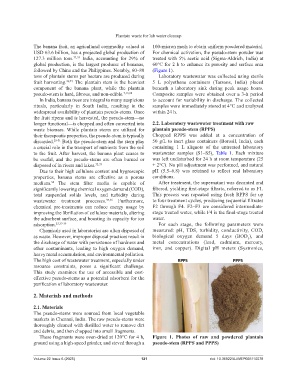
                USD 63.6 billion, has a projected global production of   For chemical activation, the pseudo-stem powder was
                127.3 million tons. 22,24  India, accounting for 29% of   treated with 5% acetic acid (Sigma-Aldrich, India) at
                global production, is the largest producer of bananas,   60°C for 2 h to enhance its porosity and surface area
                followed by China and the Philippines. Notably, 60–80   (Figure 1).
                tons of plantain stems per hectare are produced during   Laboratory wastewater was collected using sterile
                fruit  harvesting. 26,27  The  plantain  stem  is the  heaviest   5  L polyethene containers (Tarsons, India) placed
                component  of the banana  plant, while the plantain   beneath a laboratory sink during peak usage hours.
                pseudo-stem is hard, fibrous, and non-edible. 7,13,28  Composite samples were obtained over a 3-h period
                  In India, banana trees are integral to many auspicious   to account for variability in discharge. The collected
                rituals,  particularly  in  South India,  resulting  in the   samples were immediately stored at 4°C and analyzed
                widespread availability of plantain pseudo-stems. Once   within 24 h.
                the fruit ripens and is harvested, the pseudo-stem—no
                longer functional—is chopped and often converted into   2.2. Laboratory wastewater treatment with raw
                waste  biomass.  While  plantain  stems  are  utilized  for   plantain pseudo-stem (RPPS)
                their therapeutic properties, the pseudo-stem is typically   Chopped  RPPS was added  at  a  concentration  of
                discarded. 29-31  Both the pseudo-stem and the stem play   50 g/L to inert glass containers (Borosil, India), each
                a crucial role in the transport of nutrients from the soil   containing  1  L  aliquots  of  the  untreated  laboratory
                to  the  fruit. After  harvest,  the  banana  plant  ceases  to   wastewater samples (S1–S5),  Table  1. Each mixture
                be useful, and the pseudo-stems are often burned or   was left undisturbed for 24 h at room temperature (25
                disposed of in rivers and lakes. 32,33              ± 2°C). No pH adjustment was performed, and natural
                  Due to their high cellulose content and hygroscopic   pH  (5.5–6.8)  was  retained  to  reflect  real  laboratory
                properties,  banana  stems  are  effective  as  a  porous   conditions.
                medium.   The  stem  filter  media  is  capable  of    After treatment, the supernatant was decanted and
                        34
                significantly lowering chemical oxygen demand (COD),   filtered, yielding first-stage filtrate, referred to as F1.
                total suspended solids levels, and turbidity during   This process was repeated using fresh RPPS for up
                wastewater treatment  processes. 35,36  Furthermore,   to four treatment cycles, producing sequential filtrates
                chemical  pre-treatments  can reduce energy usage by   F2 through F4. F2–F3 are considered intermediate-
                improving the fibrillation of cellulose materials, altering   stage treated water, while F4 is the final-stage treated
                the adsorbent surface, and boosting its capacity for ion   water.
                adsorption. 22,37-39                                   For each stage, the following parameters were
                  Chemicals used in laboratories are often disposed of   measured: pH,  TDS, turbidity, conductivity, COD,
                as waste. However, improper disposal practices result in   biological  oxygen demand 5  days (BOD ), and
                                                                                                              5
                the discharge of water with persistence of hardness and   metal concentrations (lead, cadmium, mercury,
                other contaminants,  leading  to high oxygen demand,   iron, and copper). Digital pH meters (Systronics,
                heavy metal accumulation, and environmental pollution.
                The high cost of wastewater treatment, especially under
                resource  constraints,  poses  a  significant  challenge.
                This  study examines  the  use of accessible  and  cost-
                effective pseudo-stems as a potential adsorbent for the
                purification of laboratory wastewater.

                2. Materials and methods

                2.1. Materials
                The pseudo-stems were sourced from local vegetable
                markets in Chennai, India. The raw pseudo-stems were
                thoroughly cleaned with distilled water to remove dirt
                and debris, and then chopped into small fragments.
                  These fragments were oven-dried at 120°C for 4 h,   Figure  1. Photos of raw and powdered plantain
                ground using a high-speed grinder, and sieved through a   pseudo-stem (RPPS and PPPS)


                Volume 22 Issue 6 (2025)                       121                           doi: 10.36922/AJWEP025110078

