


Page 131 - AJWEP-22-6
P. 131
Plantain waste for lab water cleanup

                  A                              B                                C


                  D                               E                                 F


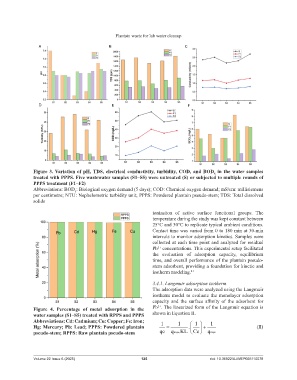
                Figure 3. Variation of pH, TDS, electrical conductivity, turbidity, COD, and BOD  in the water samples
                                                                                               5
                treated with PPPS. Five wastewater samples (S1–S5) were untreated (S) or subjected to multiple rounds of
                PPPS treatment (F1–F2)
                Abbreviations: BOD : Biological oxygen demand (5 days); COD: Chemical oxygen demand; mS/cm: millisiemens
                                  5
                per centimetre; NTU: Nephelometric turbidity unit; PPPS: Powdered plantain pseudo-stem; TDS: Total dissolved
                solids

                                                                    ionization of active surface functional groups.  The
                                                                    temperature during the study was kept constant between
                                                                    25°C and 30°C to replicate typical ambient conditions.
                                                                    Contact time was varied from 0 to 180 min at 30-min
                                                                    intervals to monitor adsorption kinetics. Samples were
                                                                    collected at each time point and analyzed for residual
                                                                    Pb²⁺ concentrations. This experimental setup facilitated
                                                                    the  evaluation  of  adsorption  capacity,  equilibrium
                                                                    time, and overall performance of the plantain pseudo-
                                                                    stem adsorbent, providing a foundation for kinetic and
                                                                    isotherm modeling. 41

                                                                    3.4.1. Langmuir adsorption isotherm
                                                                    The adsorption data were analyzed using the Langmuir
                                                                    isotherm model to evaluate the monolayer adsorption
                                                                    capacity  and  the  surface  affinity  of  the  adsorbent  for
                Figure  4. Percentage of metal adsorption in the    Pb²⁺. The linearized form of the Langmuir equation is
                water samples (S1–S5) treated with RPPS and PPPS    shown in Equation II.
                Abbreviations: Cd: Cadmium; Cu: Copper; Fe: Iron;
                Hg: Mercury; Pb: Lead; PPPS: Powdered plantain          1     1    .   1    1                 (II)


                pseudo-stem; RPPS: Raw plantain pseudo-stem            qe   qmax. KL  Ce   qmax


                Volume 22 Issue 6 (2025)                       125                           doi: 10.36922/AJWEP025110078

