


Page 133 - AJWEP-22-6
P. 133
Plantain waste for lab water cleanup

                adsorbed molecules were observed, further supporting
                the validity of the Langmuir assumptions.

                3.4.2. Freundlich adsorption isotherm
                The experimental adsorption data were also evaluated
                using the Freundlich isotherm, an empirical  model
                describing adsorption on heterogeneous surfaces. The
                linearized form of the Freundlich equation is given in
                Equation III.

                   ln q    ln K   1  In Ce                 (III)
                      e        F
                                  n
                  where, qe =  Amount of adsorbate  adsorbed at
                equilibrium (mg/g)
                  KF= Freundlich adsorption  constant  indicative  of
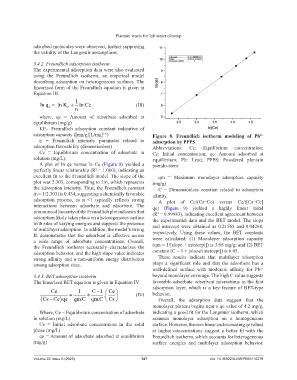
                adsorption capacity ([mg/g][L/mg] )                 Figure  8. Freundlich isotherm  modeling  of Pb
                                              1/n
                                                                                                                    2+
                  n  =  Freundlich  intensity  parameter  related  to   adsorption by PPPS
                adsorption favorability (dimensionless)             Abbreviations:  Ce:   Equilibrium   concentration;
                  Ce  =  Equilibrium  concentration  of  adsorbate  in   Cs: Initial concentration; qe:  Amount adsorbed at
                solution (mg/L).                                    equilibrium; Pb: Lead; PPPS: Powdered plantain
                  A  plot  of  ln  qe  versus ln  Ce  (Figure  8)  yielded  a   pseudo-stem
                perfectly linear relationship (R² = 1.000), indicating an
                excellent fit to the Freundlich model. The slope of the   qm = Maximum monolayer adsorption capacity
                plot was 2.303, corresponding to 1/n, which represents   (mg/g)
                the adsorption intensity. Thus, the Freundlich constant   C  =  Dimensionless  constant  related  to  adsorption
                (n = 1/2.303) is 0.434, suggesting a chemically favorable   affinity.
                adsorption  process,  as  n  <1  typically  reflects  strong   A  plot  of  Ce/(Cs−Ce)  versus  Ce/([Cs−Ce]
                interactions  between adsorbate  and adsorbent.  The   qe)  (Figure  9) yielded  a  highly  linear  trend
                pronounced linearity of the Freundlich plot indicates that   (R  = 0.99983), indicating excellent agreement between
                                                                      2
                adsorption likely takes place on a heterogeneous surface   the experimental data and the BET model. The slope
                with sites of varying energies and supports the presence
                of multilayer adsorption. In addition, the model’s strong   and intercept  were obtained as 0.21563 and 0.04268,
                fit  demonstrates  that  the  adsorbent  is  effective  across   respectively. Using these values, the BET constants
                a wide range  of adsorbate  concentrations.  Overall,   were calculated:  (1) Monolayer adsorption capacity
                the Freundlich isotherm  accurately  characterizes  the   (qm = 1/[slope + intercept]) is 3.98 mg/g; and (2) BET
                adsorption behavior, and the high slope value indicates   constant (C = 1 + [slope/intercept]) is 6.05.
                strong  affinity  and  a  non-uniform  energy  distribution   These results indicate  that  multilayer  adsorption
                among adsorption sites.                             plays  a  significant  role  and  that  the  adsorbent  has  a
                                                                    well-defined  surface  with  moderate  affinity  for  Pb²⁺
                3.4.3. BET adsorption isotherm                      beyond monolayer coverage. The high C value suggests
                The linearized BET equation is given in Equation IV.  favorable adsorbate–adsorbent interactions in the first
                                                                    adsorption layer, which is a key feature of BET-type
                       Ce          1    C 1   Ce        (IV)   behavior.


                                               .
                    Cs Ce qe    qm C .  qm C   Cs                 Overall, the adsorption data suggest that the
                                            .
                                                                    monolayer plateau begins near a qe value of 4.2 mg/g,
                  Where, Ce = Equilibrium concentration of adsorbate   indicating a good fit for the Langmuir isotherm, which
                in solution (mg/L)                                  assumes monolayer adsorption on a homogeneous
                  Cs = Initial  adsorbate  concentration  in  the  solid   surface. However, the non-linear and increasing qevalues

                phase (mg/L)                                        at  higher  concentrations  suggest  a  better  fit  with  the
                  qe = Amount of adsorbate adsorbed at equilibrium   Freundlich isotherm, which accounts for heterogeneous
                (mg/g)                                              surface energies and multilayer adsorption behavior.


                Volume 22 Issue 6 (2025)                       127                           doi: 10.36922/AJWEP025110078

