


Page 134 - AJWEP-22-6
P. 134
Kuppusamy and Dhanasamy


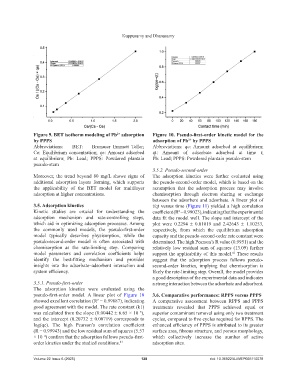
                Figure 9. BET isotherm modeling of Pb  adsorption   Figure 10. Pseudo-first-order kinetic model for the
                                                     2+
                by PPPS                                             adsorption of Pb  by PPPS
                                                                                    2+
                Abbreviations:   BET:     Brunauer–Emmett–Teller;   Abbreviations:  qe:  Amount  adsorbed  at  equilibrium;
                Ce: Equilibrium  concentration;  qe: Amount adsorbed   qt:  Amount  of adsorbate  adsorbed  at  time  t;
                at  equilibrium;  Pb: Lead;  PPPS: Powdered plantain   Pb: Lead; PPPS: Powdered plantain pseudo-stem
                pseudo-stem
                                                                    3.5.2. Pseudo-second-order
                Moreover, the  trend  beyond 80  mg/L shows signs of   The adsorption kinetics were further evaluated using
                additional  adsorption  layers  forming,  which  supports   the pseudo-second-order model, which is based on the
                the applicability  of the BET model for multilayer   assumption that the adsorption process may involve
                adsorption at higher concentrations.                chemisorption through electron sharing or exchange
                                                                    between the adsorbent and adsorbate. A linear plot of
                3.5. Adsorption kinetics                            t/qt versus time (Figure 11) yielded a high correlation
                Kinetic  studies  are  crucial  for understanding  the   coefficient (R  = 0.99023), indicating that the experimental
                                                                                2
                adsorption mechanism and rate-controlling  steps,   data fit the model well. The slope and intercept of the
                which aid in optimizing adsorption processes. Among   plot were 0.2294 ± 0.01019 and 2.42643 ± 1.10253,
                the  commonly  used  models,  the  pseudo-first-order   respectively,  from  which the equilibrium  adsorption
                model  typically  describes  physisorption,  while  the   capacity and the pseudo-second-order rate constant were
                pseudo-second-order model is often associated with   determined. The high Pearson’s R value (0.9951) and the
                chemisorption  as the rate-limiting  step. Comparing   relatively low residual sum of squares (13.09) further
                model  parameters  and  correlation  coefficients  helps   support the applicability of this model.  These results
                                                                                                       41
                identify  the  best-fitting  mechanism  and  provides   suggest that the adsorption process follows pseudo-
                insights  into  the  adsorbate–adsorbent  interaction  and   second-order kinetics, implying that chemisorption is
                system efficiency.                                  likely the rate-limiting step. Overall, the model provides
                                                                    a good description of the experimental data and indicates
                3.5.1. Pseudo-first-order                           a strong interaction between the adsorbate and adsorbent.
                The adsorption kinetics  were evaluated  using the
                pseudo-first-order  model.  A  linear  plot  of  Figure  10   3.6. Comparative performance: RPPS versus PPPS
                showed excellent correlation (R  = 0.99887), indicating   A comparative  assessment between  RPPS and PPPS
                                            2
                good agreement with the model. The rate constant (k1)   treatments  revealed  that  PPPS achieved  equal  or
                was calculated from the slope (0.00442 ± 6.65 × 10⁻⁵),   superior contaminant removal using only two treatment
                and the intercept (0.20732 ± 0.00719) corresponds to   cycles, compared to five cycles required for RPPS. The
                log(qe).  The  high  Pearson’s  correlation  coefficient   enhanced efficiency of PPPS is attributed to its greater
                (R = 0.99943) and the low residual sum of squares (5.57   surface area, fibrous structure, and porous morphology,
                × 10⁻⁴) confirm that the adsorption follows pseudo-first-  which collectively increase the number of active
                order kinetics under the studied conditions. 41     adsorption sites.


                Volume 22 Issue 6 (2025)                       128                           doi: 10.36922/AJWEP025110078

