


Page 135 - AJWEP-22-6
P. 135
Plantain waste for lab water cleanup


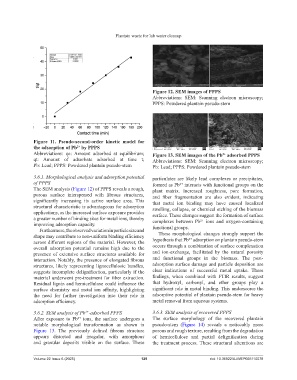
                                                                    Figure 12. SEM images of PPPS
                                                                    Abbreviations:  SEM: Scanning electron  microscopy;
                                                                    PPPS: Powdered plantain pseudo-stem


                Figure  11.  Pseudo-second-order  kinetic  model  for
                the adsorption of Pb  by PPPS
                                   2+
                Abbreviations:  qe:  Amount  adsorbed  at  equilibrium;   Figure 13. SEM images of the Pb  adsorbed PPPS
                                                                                                   2+
                qt:  Amount  of adsorbate  adsorbed  at  time  t;   Abbreviations:  SEM: Scanning electron  microscopy;
                Pb: Lead; PPPS: Powdered plantain pseudo-stem       Pb: Lead; PPPS: Powdered plantain pseudo-stem

                3.6.1. Morphological analysis and adsorption potential   particulates  are likely  lead complexes  or precipitates,
                of PPPS                                             formed as Pb²⁺ interacts with functional groups on the
                The SEM analysis (Figure 12) of PPPS reveals a rough,   plant  matrix. Increased roughness, pore formation,
                porous  surface  interspersed  with  fibrous  structures,   and  fiber  fragmentation  are  also  evident,  indicating
                significantly  increasing  its  active  surface  area.  This   that  metal  ion binding  may have  caused  localized
                structural characteristic is advantageous for adsorption   swelling, collapse, or chemical etching of the biomass
                applications, as the increased surface exposure provides   surface. These changes suggest the formation of surface
                a greater number of binding sites for metal ions, thereby
                improving adsorption capacity.                      complexes  between  Pb²⁺  ions  and  oxygen-containing
                  Furthermore, the observed variation in particle size and   functional groups.
                shape may contribute to non-uniform binding efficiency   These  morphological  changes strongly support the
                across different regions of the material. However, the   hypothesis that Pb²⁺ adsorption on plantain pseudo-stem
                overall  adsorption  potential  remains  high  due  to  the   occurs through a combination of surface complexation
                presence of extensive surface structures available  for   and  ion-exchange,  facilitated  by the  natural  porosity
                interaction. Notably, the presence of elongated fibrous   and functional  groups in the biomass.  The post-
                structures, likely representing lignocellulosic bundles,   adsorption surface damage and particle deposition are
                suggests incomplete delignification, particularly if the   clear indications of successful metal  uptake.  These
                material  underwent  pre-treatment  for  fiber  extraction.   findings,  when  combined  with  FTIR  results,  suggest
                Residual lignin and hemicellulose could influence the   that  hydroxyl, carbonyl,  and ether groups play a
                surface  chemistry  and  metal  ion  affinity,  highlighting   significant role in metal binding. This underscores the
                the need for further investigation  into their  role in   adsorptive potential of plantain pseudo-stem for heavy
                adsorption efficiency.                              metal removal from aqueous systems.

                3.6.2. SEM analysis of Pb -adsorbed PPPS            3.6.3. SEM analysis of recovered PPPS
                                       2+
                After  exposure  to  Pb²⁺  ions,  the  surface  undergoes  a   The surface  morphology of the recovered  plantain
                notable morphological  transformation  as shown  in   pseudo-stem (Figure  14) reveals a noticeably  more
                Figure  13.  The  previously  defined  fibrous  structure   porous and rough texture, resulting from the degradation
                appears distorted  and irregular, with amorphous    of  hemicellulose  and  partial  delignification  during
                and granular deposits visible  on the surface.  These   the treatment process. These structural alterations are


                Volume 22 Issue 6 (2025)                       129                           doi: 10.36922/AJWEP025110078

