


Page 181 - AJWEP-22-6
P. 181
Zn accumulating behavior of L. uncinatus

                  Martínez-Alcalá et al.  reported that Zn concentrations   3.4. Metal distribution within L. uncinatus at
                                     59
                were slightly higher in shoots (46 ± 10 μg/g) than in   various zinc concentrations
                roots (34 ± 1 μg/g of L. albus cultivated for 74 days   The distribution of Zn in leaves, stems, and roots
                in calcareous pot soil containing high levels of Zn and   varied across treatments. Zn concentration in the shoots
                Pb (2,058 and 2,947 μg/g, respectively). Similar shoot   (stems and leaves) increased, while root concentrations
                concentrations (40–70 μg/g) were reported in L. albus   decreased, with increasing Zn supply levels from 200 to
                without  apparent  detrimental  effects.  In contrast,   600 mg Zn/kg (Figure 3).
                                                   60
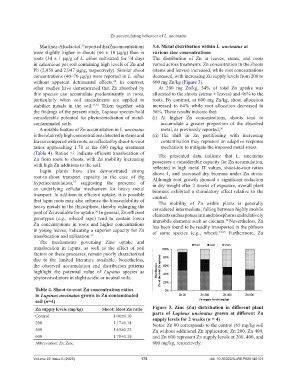
                other studies have demonstrated that Zn absorbed by    At  200  mg  Zn/kg,  54%  of  total  Zn  uptake  was
                this species can accumulate  predominantly  in roots,   allocated to the shoots (stems + leaves) and 46% to the
                particularly  when soil amendments  are applied  to   roots. By contrast, at 600 mg Zn/kg, shoot allocation
                stabilize  metals in the  soil. 31,61   Taken  together  with   increased  to  64%  while  root  allocation  decreased  to
                the findings of the present study, Lupinus species hold   36%. These results indicate that:
                considerable potential  for phytoremediation  of metal-  (i)  At higher  Zn concentrations,  shoots tend  to
                contaminated soils.                                     accumulate  a greater proportion of the absorbed
                  A notable feature of Zn accumulation in L. uncinatus   metal, as previously reported; 36
                is the relatively high concentrations detected in stems and   (ii)  The shift in Zn partitioning with increasing
                leaves compared with roots, as reflected by shoot-to-root   contamination may represent an adaptive response
                ratios approaching 1.78 at the 600  mg/kg treatment     mechanism to mitigate the imposed metal stress.
                (Table 4). Ratios >1 indicate efficient translocation of   The presented data indicate  that L. uncinatus
                Zn from roots to shoots, with Zn mobility increasing   possesses a considerable capacity for Zn accumulation,
                with high Zn additions to the soil.                 reflected in high metal IT values, shoot-to-root ratios
                  Lupin plants have also demonstrated  strong       above 1, and increased  dry biomass under Zn stress.
                root-to-shoot  transport  capacity  in  the  case  of Hg   Although  root  growth  showed  a  significant  reduction
                hyperaccumulation,  suggesting the presence of      in dry weight after 2 weeks of exposure, overall plant
                                 37
                an  underlying  cellular  mechanism  for  heavy  metal   biomass  exhibited  a  stimulatory  effect  relative  to  the
                transport. In addition to efficient uptake, it is possible   control.
                that lupin roots may also enhance the bioavailability of   The mobility of Zn within plants is generally
                heavy metals in the rhizosphere, thereby enlarging the   considered intermediate, falling between highly mobile
                pool of Zn available for uptake.  In general, Zn-efficient   elements such as potassium and phosphorus and relatively
                                           50
                genotypes  (e.g.,  oilseed  rape)  tend  to  contain  lower   immobile elements such as calcium. Nevertheless, Zn
                                                                                                    54
                Zn concentrations  in roots and higher concentrations   has been found to be readily transported in the phloem
                in young leaves, indicating a superior capacity for Zn   of some species  (e.g.,  wheat). 63-65  Furthermore,  Zn
                translocation and utilization. 62
                  The mechanisms  governing Zinc  uptake  and
                translocation  in  lupins,  as  well  as  the  effect  of  soil
                factors on these processes, remain poorly characterized
                due to the limited literature  available.  Nonetheless,
                the observed accumulation  and distribution patterns
                highlight  the  potential  value  of  Lupinus species  as
                phytoremediators in slight acidic or neutral soils.

                 Table 4. Shoot-to-root Zn concentration ratios
                 in Lupinus uncinatus grown in Zn-contaminated
                 soil (n=4)
                 Zn supply levels (mg/kg)     Shoot: Root Zn ratio  Figure  3.  Zinc  (Zn)  distribution  in  different  plant
                 Control                           1.06±0.10        parts of  Lupinus  uncinatus  grown  at  different  Zn
                                                                    supply levels for 2 weeks (n = 4)
                 200                               1.17±0.14        Notes: Zn 00 corresponds to the control (65 mg/kg soil
                 400                               1.63±0.22        Zn without additional Zn application; Zn 200, Zn 400,
                 600                               1.78±0.19        and Zn 600 represent Zn supply levels at 200, 400, and
                 Abbreviation: Zn: Zinc.                            600 mg/kg, respectively.


                Volume 22 Issue 6 (2025)                       175                           doi: 10.36922/AJWEP025140101

