


Page 180 - AJWEP-22-6
P. 180
Ehsan, et al.

                Table 3. Comparison of different phytoremediation strategies
                Plant                   Zinc       Zinc concentration in   Medium, time of       Tolerance  References
                                   Concentration in  plant (mg/kg)         exposure              index (%)
                                   medium (mg/kg)
                Lupinus uncinatus        600       10,000 (root); 18,000   Soil in pot, 14 days     149    The present
                                                   (shoot)                                                   study
                Lupinus albus            500       5,200 (root); 1,638 (shoot)  Soil in pots, 84 days  38      32
                Brassica juncea        6.5 mg/L    10,000 (root); 1,500 (shoot) Hydroponics, 12 days  122      49
                Thlaspi caerulescens     210       1,200 (root); 8,700 (shoot)  Soil in pots (industrial   –   50
                                                                           contamination), 100 days
                Hordeum vulgare          100       1 (root); 4.5 (plant)   Soil in pots, 48 days    41         51
                (barley, non-tolerant)

                of  metals  within  plants,  particularly  their  transport
                from roots to aerial tissues. Despite the relative short
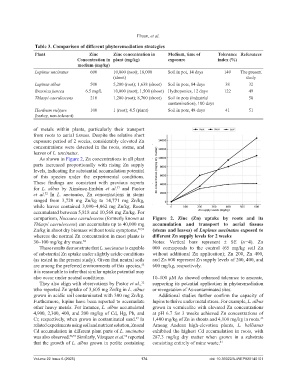
                exposure period of 2 weeks, considerably elevated Zn
                concentrations  were detected in the roots, stems, and
                leaves of L. uncinatus.
                  As shown in Figure 2, Zn concentrations in all plant
                parts increased  proportionally  with rising Zn supply
                levels, indicating the substantial accumulation potential
                of this species under the experimental  conditions.
                These  findings  are  consistent  with  previous  reports
                for  L.  albus  by Ximénez-Embún  et  al.   and  Pastor
                                                    37
                et al.  In  L. uncinatus, Zn concentrations  in stems
                     32
                ranged from 3,720  mg Zn/kg to 14,771  mg Zn/kg,
                while leaves contained 3,090–4,062 mg Zn/kg. Roots
                accumulated between 5,818 and 10,568 mg Zn/kg. For
                comparison, Noccaea caerulescens (formerly known as   Figure  2. Zinc (Zn) uptake  by roots and  its
                Thlaspi caerulescens) can accumulate up to 40,000 mg   accumulation and transport to aerial tissues
                Zn/kg in shoot dry biomass without toxic symptoms, 52,53    (stems and leaves) of Lupinus uncinatus exposed to
                whereas the normal Zn concentration in most plants is   different Zn supply levels for 2 weeks
                30–100 mg/kg dry mass. 54                           Notes:  Vertical  bars represent ± SE (n=4). Zn
                  These results demonstrate that L. uncinatus is capable   000  corresponds to the control (65  mg/kg soil Zn
                of substantial Zn uptake under slightly acidic conditions   without additional  Zn application); Zn 200, Zn 400,
                (as tested in the present study). Given that neutral soils   and Zn 600 represent Zn supply levels of 200, 400, and
                are among the preferred environments of this species,    600 mg/kg, respectively.
                                                               55
                it is reasonable to infer that similar uptake potential may
                also occur under neutral conditions.                10–100 μM As showed enhanced tolerance to arsenate,
                  They also align with observations by Pastor et al.,    supporting its potential application in phytoremediation
                                                               32
                who reported Zn uptake of 3,605 mg Zn/kg in L. albus   or revegetation of As-contaminated sites.
                grown in acidic soil contaminated with 300 mg Zn/kg.   Additional  studies  further  confirm  the  capacity  of
                Furthermore,  lupins  have  been  reported  to  accumulate   lupins to thrive under metal stress. For example, L. albus
                other heavy metals. For instance, L. albus accumulated   grown in vermiculite with elevated Zn concentrations
                4,900, 2,300, 400, and 200  mg/kg of Cd, Hg, Pb, and   at pH 6.7 for 3 weeks achieved Zn concentrations of
                Cr, respectively, when grown in contaminated sand.  In   1,400 mg/kg of Zn in shoots and 4,100 mg/kg in roots.
                                                             37
                                                                                                                    32
                related experiments using soil and nutrient solution, Zn and   Among  Andean  high-elevation  plants,  L. ballianus
                Cd accumulation in different plant parts of L. uncinatus   exhibited  the  highest  Cd accumulation  in roots, with
                was also observed. 56,57  Similarly, Vázquez et al.  reported   287.3  mg/kg  dry matter  when grown in  a  substrate
                                                        58
                that the growth of L. albus grown in perlite containing   consisting entirely of mine waste. 41


                Volume 22 Issue 6 (2025)                       174                           doi: 10.36922/AJWEP025140101

