


Page 179 - AJWEP-22-6
P. 179
Zn accumulating behavior of L. uncinatus

                with increasing Zn supply levels, as expected. At the   Zinc treatments appeared to have a stimulatory effect
                600 mg/kg treatment, root dry matter was reduced by   on plant dry matter yield, as IT values for Zn supply
                57% compared to control plants.                     levels of 200, 400, and 600 mg/kg were 146%, 134% and
                  The negative effects of toxic elements on root growth   150% respectively. Two fundamental mechanisms have
                are well documented. For example, Luo et al.  reported   been reported for plant tolerance to toxic elements: Metal
                                                       38
                that elevated Zn levels inhibited the growth of Jatropha   exclusion  and  metal  detoxification.  In the exclusion
                                                                                                    46
                seedlings by disrupting normal cellular metabolism and   pathway, plants restrict metal absorption into the roots,
                inducing  visible  injuries  and  physiological  disorders.   thereby preventing translocation and accumulation in aerial
                Moreover, root growth was identified as the first visible   tissues.  By contrast, hyperaccumulator species actively
                                                                          47
                site of damage under excessive Zn, due to reduced cell   take up toxic elements and tolerate them through internal
                division.  Additionally, cell walls have been reported   detoxification  mechanisms.  Several  hyperaccumulator
                       39
                to rupture under physical  stress when their  elasticity   species have been identified for Zn. To cope with excess
                is  significantly  reduced  by  Pb  and  Cd  exposure.    Zn in  the  cytoplasm,  plants  may  employ  one  or  more
                                                               40
                Significant  decreases  in  plant  biomass  production   of the following pathways: (i)  Reduced accumulation
                have also been reported  in  Lupinus ballianus  and   across the plasma membrane, (ii) sequestration in
                                                           41
                Lupinus termis  when  grown  either  in  100%  mine   subcellular organelles, (iii)  precipitation as insoluble
                waste substrates containing 3,780 mg/kg Zn or in soil-  salts, (iv) binding of Zn to low-molecular-weight
                filled pots supplemented with 100 mg/L Zn solutions,   organic compounds, and (v) removal through the plasma
                respectively. 42                                    membrane into the apoplast. 48
                  Shoot dry matter yield per pot ranged from 1.90 g    The IT values obtained in this study were compared
                to  3.36  g. A  significant  increase  in  shoot  dry  matter   with those reported in other investigations (Table 3). The
                was observed compared to the control, and total plant   results indicate that Lupinus species (both L. uncinatus
                biomass followed the same trend. Similar increases in   in the  present  study and  L. albus ) exhibited  a high
                                                                                                   32
                plant  biomass in response to heavy  metal  treatments   capacity for Zn accumulation and efficient translocation
                have been reported by other researchers for Mn and   to aerial tissues, particularly the stem, and consequently
                copper,  as well as Cd. 44,45                       demonstrated higher tolerance indices compared to other
                      43
                                                                    hyperaccumulator plants. However, these comparisons
                3.2. Metal tolerance                                should be interpreted  cautiously, as the experimental
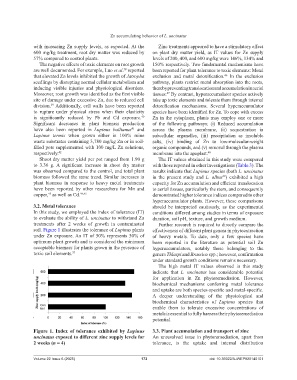
                In this study, we employed the index of tolerance (IT)   conditions differed among studies in terms of exposure
                to evaluate the ability of L. uncinatus to withstand Zn   duration, soil pH, texture, and growth medium.
                treatments  after 2  weeks of growth in contaminated   Further research is required to directly compare the
                soil. Figure 1 illustrates the tolerance of Lupinus plants   effectiveness of different plant genera in phytoextraction
                under Zn exposure. An IT of 50% represents 50% of   of heavy metals.  To date, only a few species have
                optimum plant growth and is considered the minimum   been reported in the literature as potential soil Zn
                acceptable biomass for plants grown in the presence of   hyperaccumulators, notably those belonging to the
                toxic soil elements. 37                             genera Thlaspi and Brassica spp.; however, confirmation
                                                                    under standard growth conditions remains necessary.
                                                                       The high metal IT values observed in this study
                                                                    indicate  that  L. uncinatus has considerable  potential
                                                                    for application in Zn phytoremediation.  However,
                                                                    biochemical  mechanisms  conferring  metal  tolerance
                                                                    and uptake are both species-specific and metal-specific.
                                                                    A  deeper  understanding  of the  physiological  and
                                                                    biochemical  characteristics  of  Lupinus species that
                                                                    enable them to tolerate  excessive concentrations  of
                                                                    metals is essential to fully harness their phytoremediation
                                                                    potential.

                Figure  1. Index of tolerance  exhibited by  Lupinus   3.3. Plant accumulation and transport of zinc
                uncinatus exposed to different zinc supply levels for   An unresolved issue in phytoremediation,  apart  from
                2 weeks (n = 4)                                     tolerance,  is  the  uptake  and  internal  distribution


                Volume 22 Issue 6 (2025)                       173                           doi: 10.36922/AJWEP025140101

