


Page 55 - AJWEP-22-6
P. 55
Statistical analysis of wind energy
(ii) The average wind speed in Mongo is ≥ 3.0 m/s, complying with World Meteorological Organization
corresponding to wind power Class 1, which is standards, ensuring measurement precision of ± 0.1 m/s
suitable for limited applications for wind speed and ± 0.5°C for temperature. The
(iii) The prevailing wind direction is predominantly temporal resolution of the data used in this study is
south-southwest, consistent with regional climatic monthly, derived as averages from hourly recordings.
patterns The collected data underwent rigorous quality control
(iv) The estimated wind power density is sufficient to detect anomalies and interpolate missing values to
to support standalone micro-generation systems ensure reliability. 7,23
(<30 W/m²).
2.2. Statistical modeling of wind speed using the
These hypotheses were tested through descriptive Weibull distribution
statistical analysis, parameter estimation, and The statistical modeling of wind speed is crucial for
comparison with international wind classification accurate wind energy assessment. Among the various
standards. The study also analyzed wind power potential models proposed in the literature, the two-parameter
using both annual and monthly assessments, accounting
for variability and reliability. Although this study does Weibull distribution remains the most widely used due
not include a full economic feasibility assessment, to its flexibility and good fit to empirical data across
many geographical regions.
The Weibull probability
12,16
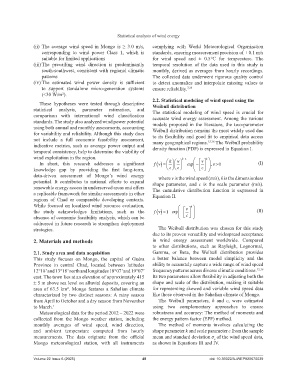
indicative metrics, such as average power output and density function (PDF) is expressed in Equation I.
temporal consistency, help to determine the viability of
wind exploitation in the region. k −1 k
k
v
v
In short, this research addresses a significant f v exp − , 0 (I)
v
>
( ) =
c
knowledge gap by providing the first long-term, c c
data-driven assessment of Mongo’s wind energy where v is the wind speed (m/s), k is the dimensionless
potential. It contributes to national efforts to expand shape parameter, and c is the scale parameter (m/s).
renewable energy access in underserved areas and offers The cumulative distribution function is expressed in
a replicable framework for similar assessments in other Equation II.
regions of Chad or comparable developing contexts.
While focused on localized wind resource evaluation, k
v
the study acknowledges limitations, such as the ( ) =f v 1 − −exp (II)
absence of economic feasibility analysis, which can be c
addressed in future research to strengthen deployment
strategies. The Weibull distribution was chosen for this study
due to its proven versatility and widespread acceptance
2. Materials and methods in wind energy assessment worldwide. Compared
to other distributions, such as Rayleigh, Lognormal,
2.1. Study area and data acquisition Gamma, or Beta, the Weibull distribution provides
This study focuses on Mongo, the capital of Guéra a better balance between model simplicity and the
Province in central Chad, located between latitudes ability to accurately capture a wide range of wind speed
12°18’ and 13°18’ north and longitudes 18°07’ and 19°07’ frequency patterns across diverse climatic conditions. 12,16
east. The town lies at an elevation of approximately 415 Its two parameters allow flexibility in adjusting both the
± 5 m above sea level on alluvial deposits, covering an shape and scale of the distribution, making it suitable
area of 63.5 km². Mongo features a Sahelian climate for representing skewed and variable wind speed data
characterized by two distinct seasons: A rainy season like those observed in the Sahelian climate of Mongo.
from April to October and a dry season from November The Weibull parameters, k and c, were estimated
to March. 1 using two complementary approaches to ensure
Meteorological data for the period 2012 – 2022 were robustness and accuracy: The method of moments and
collected from the Mongo weather station, including the energy pattern factor (EPF) method.
monthly averages of wind speed, wind direction, The method of moments involves calculating the
and ambient temperature computed from hourly shape parameter k and scale parameter c from the sample
measurements. The data originate from the official mean and standard deviation σ of the wind speed data,
v
Mongo meteorological station, with all instruments as shown in Equations III and IV.
Volume 22 Issue 6 (2025) 49 doi: 10.36922/AJWEP025070039

