


Page 75 - AJWEP-22-6
P. 75
Pine sawdust biofuel: Quality and temperature optimization

                                                                    to  reduced  relaxed  density.  This  phenomenon  likely
                                                                    resulted from insufficient lignin softening and bonding
                                                                    under non-uniform temperature conditions.
                                                                       A moderately  negative correlation  (ρ  =  −0.500,
                                                                    p=0.011)  exists  between  MSD  and  impact  resistance,
                                                                    attributable to structural  inhomogeneity  caused  by
                                                                    uneven heat distribution. However, the non-significant
                                                                    relationship with relaxation ratio (ρ = −0.199, p=0.339)
                                                                    suggests minimal MSD influence, implying dominant
                                                                    effects from other factors.
                                                                       Temperature  field  uniformity  critically  affects
                                                                    densified biofuel quality. Uniform heating (low MSD)
                                                                    promotes  homogeneous  lignin  activation,  enhancing
                                                                    interparticle bonding and consequently improving both
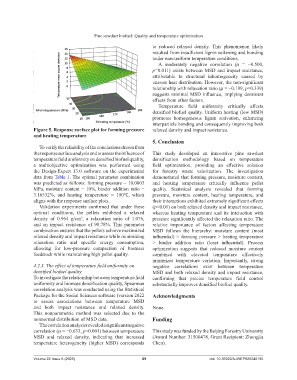
                Figure 5. Response surface plot for forming pressure   relaxed density and impact resistance.
                and heating temperature
                                                                    5. Conclusion
                  To verify the reliability of the conclusions drawn from
                the response surface analysis and to assess the influence of   This study developed  an innovative  pine sawdust
                temperature field uniformity on densified biofuel quality,   densification  methodology  based  on  temperature
                a multiobjective optimization was performed  using   field  optimization,  providing  an  effective  solution
                the  Design-Expert  13.0  software  on  the  experimental   for forestry waste valorization.  The investigation
                data from Table 1. The optimal parameter combination   demonstrated that forming pressure, moisture content,
                was predicted as follows: forming pressure = 10.0003   and  heating  temperature  critically  influence  pellet
                MPa, moisture content = 10%, binder addition ratio =   quality.  Statistical  analysis  revealed  that  forming
                3.16532%, and heating temperature  = 190℃, which    pressure, moisture  content,  heating  temperature,  and
                aligns with the response surface plots.             their interactions exhibited extremely significant effects
                  Validation  experiments  confirmed  that  under  these   (p<0.01) on both relaxed density and impact resistance,
                optimal  conditions,  the  pellets  exhibited  a  relaxed   whereas heating  temperature  and  its interaction  with
                density of 0.964  g/cm , a relaxation  ratio of 1.076,   pressure significantly affected the relaxation ratio. The
                                     3
                and  an impact resistance  of 98.78%.  This  parameter   relative  importance  of  factors  affecting  temperature
                combination ensures that the pellets achieve maximized   MSD  follows  the  hierarchy:  moisture  content  (most
                relaxed density and impact resistance while minimizing   influential) > forming pressure > heating temperature
                relaxation  ratio  and  specific  energy  consumption,   >  binder  addition  ratio  (least  influential).  Process
                allowing  for low-pressure compaction  of biomass   optimization  suggests that  reduced moisture  content
                feedstock while maintaining high pellet quality.    combined  with  elevated  temperature  effectively
                                                                    minimizes  temperature  variation.  Importantly, strong
                4.2.3. The effect of temperature field uniformity on   negative  correlations  exist between temperature
                densified biofuel quality                           MSD and both relaxed density and impact resistance,
                To investigate the relationship between temperature field   confirming  that  precise  temperature  field  control
                uniformity and biomass densification quality, Spearman   substantially improves densified biofuel quality.
                correlation analysis was conducted using the Statistical
                Package for the Social Sciences software (version 2022   Acknowledgments
                to  assess  associations  between  temperature  MSD
                and both impact  resistance and relaxed density.    None.
                This  nonparametric  method  was selected  due  to the
                nonnormal distribution of MSD data.                 Funding
                  The correlation analysis revealed a significant negative
                correlation (ρ = −0.633, p<0.001) between temperature   This study was funded by the Beijing Forestry University
                MSD  and  relaxed  density,  indicating  that  increased   (Award Number: 31500478, Grant Recipient: Zhongjia
                temperature  heterogeneity  (higher  MSD)  corresponds   Chen).


                Volume 22 Issue 6 (2025)                        69                           doi: 10.36922/AJWEP025240195

