


Page 72 - AJWEP-22-6
P. 72
Chen, et al.

                 Table 3. Influence the degree of each test factor on each evaluation index of densified biofuel quality
                 Dependent             Forming        Moisture          Binder            Heating         Interaction
                 variables             pressure        content       addition ratio     temperature          effect
                 Relaxed density        0.0008        <0.0001           0.5005             0.0008          BD−0.0063
                 Relaxation ratio       0.0568         0.5667           0.5723             0.0082         AD−0.0037
                 Impact resistance      0.0096         0.0003           0.2375             0.0806          BD−0.0064
                 Note: A is forming pressure, B is moisture content, and D is heating temperature.


                              A


                              B


                              C


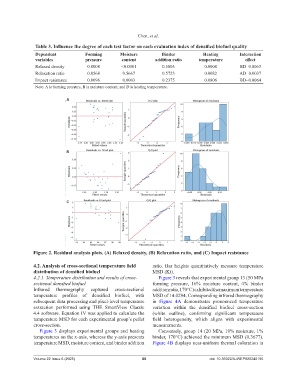
                Figure 2. Residual analysis plots. (A) Relaxed density, (B) Relaxation ratio, and (C) Impact resistance


                4.2. Analysis of cross-sectional temperature field   ratio.  Bar  heights  quantitatively  measure  temperature
                distribution of densified biofuel                   MSD (Kt).
                4.2.1. Temperature distribution and results of cross-  Figure 3 reveals that experimental group 13 (50 MPa
                sectional densified biofuel                         forming pressure, 16% moisture content, 4% binder
                Infrared  thermography   captured   cross-sectional  addition ratio, 170°C) exhibited the maximum temperature
                temperature  profiles  of  densified  biofuel,  with   MSD of 14.0294. Corresponding infrared thermography
                subsequent data processing and pixel-level temperature   in  Figure  4A demonstrates  pronounced  temperature
                extraction  performed using  THE SmartView Classic   variation  within  the  densified  biofuel  cross-section
                4.4 software. Equation IV was applied to calculate the   (white  outline),  confirming  significant  temperature
                temperature MSD for each experimental group’s pellet   field  heterogeneity,  which  aligns  with  experimental
                cross-section.                                      measurements.
                  Figure 3 displays experimental groups and heating    Conversely, group 14 (20 MPa, 10% moisture, 1%
                temperatures on the x-axis, whereas the y-axis presents   binder, 170°C) achieved the minimum MSD (0.3677).
                temperature MSD, moisture content, and binder addition   Figure 4B displays near-uniform thermal coloration in


                Volume 22 Issue 6 (2025)                        66                           doi: 10.36922/AJWEP025240195

