


Page 70 - AJWEP-22-6
P. 70
Chen, et al.


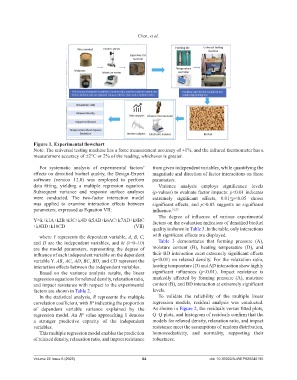
                Figure 1. Experimental flowchart
                Note: The universal testing machine has a force measurement accuracy of ±1%, and the infrared thermometer has a
                measurement accuracy of ±2°C or 2% of the reading, whichever is greater.

                  For systematic  analysis of experimental  factors’   from given independent variables, while quantifying the
                effects on densified biofuel quality, the Design-Expert   magnitude and direction of factor interactions on these
                software (version  12.0) was employed to perform    parameters.
                data  fitting,  yielding  a  multiple  regression  equation.   Variance  analysis  employs  significance  levels
                Subsequent  variance  and  response  surface  analyses   (p-values) to evaluate factor impacts: p<0.01 indicates
                were conducted.  The two-factor interaction  model   extremely  significant  effects,  0.01≤p<0.05 shows
                was  applied  to  examine  interaction  effects  between   significant effects, and p>0.05 suggests no significant
                parameters, expressed as Equation VII:              influence. 31,33
                                                                       The  degree  of  influence  of  various  experimental
                Y= k+k1A+k2B+k3C+k4D+k5AB+k6AC+k7AD+k8BC            factors on the evaluation indicators of densified biofuel
                +k9BD+k10CD                                 (VII)   quality is shown in Table 3. In the table, only interactions

                  where Y represents the dependent variable, A, B, C,   with significant effects are displayed.
                and D are the independent variables, and ki (i=0~10)   Table  3  demonstrates  that  forming  pressure  (A),
                are  the  model  parameters,  representing  the  degree  of   moisture  content  (B),  heating  temperature  (D),  and
                influence of each independent variable on the dependent   their BD interaction exert extremely significant effects
                variable Y. AB, AC, AD, BC, BD, and CD represent the   (p<0.01) on relaxed density. For the relaxation  ratio,
                interaction effects between the independent variables.  heating temperature (D) and AD interaction show highly
                  Based  on  the  variance  analysis results,  the  linear   significant  influences  (p<0.01). Impact  resistance  is
                regression equations for relaxed density, relaxation ratio,   markedly  affected  by  forming  pressure  (A),  moisture
                and impact resistance with respect to the experimental   content (B), and BD interaction at extremely significant
                factors are shown in Table 2.                       levels.
                  In the statistical analysis, R represents the multiple   To validate  the reliability  of the  multiple  linear
                correlation coefficient, with R  indicating the proportion   regression models, residual analysis was conducted.
                                          2
                of dependent variable  variance  explained  by the   As shown in Figure 2, the residuals versus fitted plots,
                regression model. An R  value approaching 1 denotes   Q–Q plots, and histogram of residuals confirm that the
                                     2
                a  stronger  predictive  capacity  of the  independent   models for relaxed density, relaxation ratio, and impact
                variables.                                          resistance meet the assumptions of random distribution,
                  This multiple regression model enables the prediction   homoscedasticity, and normality, supporting their
                of relaxed density, relaxation ratio, and impact resistance   robustness.


                Volume 22 Issue 6 (2025)                        64                           doi: 10.36922/AJWEP025240195

