


Page 74 - AJWEP-22-6
P. 74
Chen, et al.

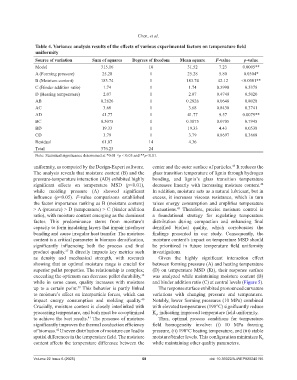
                 Table 4. Variance analysis results of the effects of various experimental factors on temperature field
                 uniformity

                 Source of variation      Sum of squares   Degrees of freedom   Mean square     F-value     p-value
                 Model                       315.16                10               31.52        7.23       0.0005**
                 A (Forming pressure)         25.28                1                25.28        5.80       0.0304*
                 B (Moisture content)        183.74                1               183.74        42.12     <0.0001**
                 C (Binder addition ratio)    1.74                 1                1.74        0.3990       0.5378
                 D (Heating temperature)      2.07                 1                2.07        0.4749       0.5020
                 AB                          0.2826                1               0.2826       0.0648       0.8028
                 AC                           3.68                 1                3.68        0.8430       0.3741
                 AD                           41.77                1                41.77        9.57       0.0079**
                 BC                          0.3075                1               0.3075       0.0705       0.7945
                 BD                           19.33                1                19.33        4.43        0.0538
                 CD                           3.79                 1                3.79        0.8697       0.3668
                 Residual                     61.07                14               4.36
                 Total                       376.23                24
                 Note: Statistical significance determined at *0.01 ≤p < 0.05 and **p<0.01.

                uniformity, as computed by the Design-Expert software.   center and the outer surface of particles.  It reduces the
                                                                                                       43
                The analysis reveals that moisture content (B) and the   glass transition temperature of lignin through hydrogen
                pressure-temperature interaction (AD) exhibited highly   bonding, and lignin’s glass transition temperature
                significant  effects  on  temperature  MSD  (p<0.01),   decreases  linearly  with  increasing  moisture  content.
                                                                                                                    44
                while  molding  pressure  (A)  showed  significant   In addition, moisture acts as a natural lubricant, but in
                influence  (p<0.05).  F-value  comparisons established   excess, it increases viscous resistance,  which in turn
                the factor importance ranking as B (moisture content)   raises  energy  consumption  and  amplifies  temperature
                > A (pressure) > D (temperature) > C (binder addition   fluctuations.   Therefore,  precise  moisture  control  is
                                                                               45
                ratio), with moisture content emerging as the dominant   a foundational strategy for regulating temperature
                factor.  This  predominance  stems  from  moisture’s   distribution  during  compaction  and  enhancing  final
                capacity to form insulating layers that impair interlayer   densified  biofuel  quality,  which  corroborates  the
                bonding and cause irregular heat transfer. The moisture   findings  presented  in  our  study.  Consequently,  the
                content is a critical parameter in biomass densification,   moisture content’s impact on temperature MSD should
                significantly  influencing  both  the  process  and  final   be  prioritized  in  future  temperature  field  uniformity
                product quality.  It directly impacts key metrics such   investigations.
                              37
                as density and mechanical  strength, with research     Given  the  highly  significant  interaction  effect
                showing that an optimal moisture range is crucial for   between forming pressure (A) and heating temperature
                superior pellet properties. The relationship is complex;   (D) on temperature MSD (Kt), their response surface
                exceeding the optimum can decrease pellet durability,    was analyzed while maintaining moisture content (B)
                                                               38
                while  in  some  cases,  quality  increases  with  moisture   and binder addition ratio (C) at central levels (Figure 5).
                up to a certain point.  This behavior is partly linked   The response surface exhibited pronounced curvature
                                   39
                to moisture’s effect on interparticle forces, which can   variations  with changing  pressure and  temperature.
                impact  energy  consumption  and  molding  quality.    Notably, lower forming pressures (10 MPa) combined
                                                               40
                Crucially, moisture content is closely interlinked with   with elevated temperatures (190°C) significantly reduce
                processing temperature, and both must be co-optimized   K , indicating improved temperature field uniformity.
                                                                      t
                to achieve the best results.  The presence of moisture   Thus,  optimal  process conditions  for temperature
                                        41
                significantly improves the thermal conduction efficiency   field  homogeneity  involve:  (i)  10  MPa  forming
                of biomass.  Uneven distribution of moisture can lead to   pressure, (ii) 190°C heating temperature, and (iii) stable
                          42
                spatial differences in the temperature field. The moisture   moisture/binder levels. This configuration minimizes K
                                                                                                                     t
                content affects the temperature difference between the   while maintaining other quality parameters.


                Volume 22 Issue 6 (2025)                        68                           doi: 10.36922/AJWEP025240195

