


Page 73 - AJWEP-22-6
P. 73
Pine sawdust biofuel: Quality and temperature optimization

                the cross-section, indicating homogeneous temperature   Other   researchers   have   employed   different
                distribution.                                       approaches  to  evaluate  temperature  field  uniformity
                  Comparative  analysis  revealed  that  non-uniform   in  their  studies.  Vanherck  et  al.   used  the  difference
                                                                                                 34
                temperature  distributions  correlated  with  surface   between  maximum  and minimum  temperatures  as
                cracking  and  rough cross-sections  with  material   an  indicator  of  temperature  uniformity.  Bai  et  al.
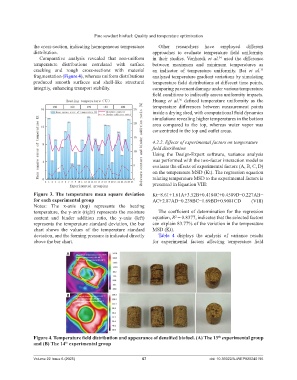
                                                                                                                    35
                fragmentation (Figure 4), whereas uniform distributions   analyzed temperature gradient variations by simulating
                produced  smooth  surfaces  and  shell-like  structural   temperature field distributions at different time points,
                integrity, enhancing transport stability.           comparing pavement damage under various temperature
                                                                    field conditions to indirectly assess uniformity impacts.
                                                                    Huang  et al.   defined  temperature  uniformity  as  the
                                                                                36
                                                                    temperature  differences  between  measurement  points
                                                                    inside a drying shed, with computational fluid dynamics
                                                                    simulations revealing higher temperatures in the bottom
                                                                    area  compared  to  the  top,  whereas  water  vapor  was
                                                                    concentrated in the top and outlet areas.

                                                                    4.2.2. Effects of experimental factors on temperature
                                                                    field distribution
                                                                    Using  the  Design-Expert  software,  variance  analysis
                                                                    was performed with the two-factor interaction model to
                                                                    evaluate the effects of experimental factors (A, B, C, D)
                                                                    on the temperature MSD (Kt). The regression equation
                                                                    relating temperature MSD to the experimental factors is
                                                                    presented in Equation VIII:
                Figure  3. The  temperature  mean  square  deviation   Kt=8.61+1.61A+3.52B+0.4184C+0.4589D−0.227AB−
                for each experimental group                         AC+2.87AD−0.239BC−1.69BD+0.9081CD           (VIII)
                Notes:  The  x-axis (top) represents  the  heating
                temperature, the y-axis (right) represents the moisture   The coefficient of determination for the regression
                content  and binder  addition  ratio,  the  y-axis (left)   equation, R  = 0.8377, indicates that the selected factors
                                                                              2
                represents the temperature standard deviation, the bar   can explain 83.77% of the variation in the temperature
                chart  shows the  values  of  the  temperature  standard   MSD (Kt).
                deviation, and the forming pressure is indicated directly   Table  4 displays the analysis of variance  results
                above the bar chart.                                for  experimental  factors  affecting  temperature  field


                              A


                              B


                Figure 4. Temperature field distribution and appearance of densified biofuel. (A) The 13  experimental group
                                                                                                 th
                and (B) The 14  experimental group
                              th

                Volume 22 Issue 6 (2025)                        67                           doi: 10.36922/AJWEP025240195

