


Page 118 - AN-2-2
P. 118
Advanced Neurology                                                           Losartan and Enalapril in SE


            cleaned in normal saline, and the blood vessels were taken   A
            out. Subsequently, the hearts were washed with normal
            saline and dried by gently blotting them on tissue paper.
            The hearts were weighed, and the heart-to-body weight
            ratio was calculated using the provided formula:  (heart
            weight [g]/body weight [g]) × 1000.
            2.6.3. Histopathology

            To conduct histopathological analysis, sections of the
            heart were fixed in 10% buffered formalin and underwent
            routine automated histokinetic processing. Paraffin blocks
            were created, and 3 – 5 µm sections were sliced using a
            microtome (Shandon AS 325). These sections were then   B
            stained with hematoxylin and eosin (H&E) to identify
            histopathological changes, such as inflammation, necrosis,
            ischemia, and fibrosis. The evaluation of these findings was
            performed by a cardiac pathologist who was unaware of
            the experimental groups.

            2.7. Statistical analysis
            The analyses were conducted by an unbiased observer
            who was unaware of the experimental groups, utilizing
            GraphPad Prism 5.0. For data relating to SCS, to ensure a
            comparable group size, data are plotted till day 15 only as
            there was mortality in LiP control group after that. While
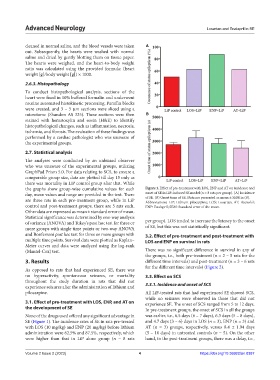
            the  graphs show group-wise cumulative values for each   Figure 1. Effect of pre-treatment with LOS, ENP and AT on incidence and
            day, mean values and range are provided in the text. There   onset of SE in LiP-induced SE model (n = 8 rats per group). (A) Incidence
                                                               of SE. (B) Onset time of SE. Data are presented as mean ± SEM in (B).
            are three rats in each pre-treatment group, while in LiP   Abbreviations: LiP: Lithium-pilocarpine; LOS: Losartan; AT: Atenolol;
            control and post-treatment groups, there are 5 rats each.   ENP: Enalapril; SEM: Standard error of the mean.
            Other data are expressed as mean ± standard error of mean.
            Statistical significance was determined by one-way analysis
            of variance (ANOVA) and Tukey’s post hoc test for three or   per group). LOS tended to increase the latency to the onset
            more groups with single time points or two-way ANOVA   of SE, but this was not statistically significant.
            and Bonferroni post hoc test for three or more groups with   3.2. Effect of pre-treatment and post-treatment with
            multiple time points. Survival data were plotted as Kaplan–  LOS and ENP on survival in rats
            Meier curves and data were analyzed using the log-rank
            (Mantel-Cox) test.                                 There was no significant difference in survival in any of
                                                               the groups, i.e., both pre-treatment (n = 2 – 5 rats for the
            3. Results                                         different time intervals) and post-treatment (n = 3 – 6 rats
                                                               for the different time intervals) (Figure 2).
            As opposed to rats that had experienced SE, there was
            no hyperactivity, spontaneous seizures, or mortality   3.3. Effect on SCS
            throughout the study duration in rats that did not
            experience seizures after the administration of lithium and   3.3.1. Incidence and onset of SCS
            pilocarpine.                                       All LiP-treated rats that had experienced SE showed SCS,
                                                               while no seizures were observed in those that did not
            3.1. Effect of pre-treatment with LOS, ENP, and AT on   experience SE. The onset of SCS ranged from 5 to 12 days.
            the development of SE                              In pre-treatment groups, the onset of SCS in all the groups
            None of the drugs used offered any significant advantage in   was earlier, i.e., 6.5 days (6 – 7 days), 6.3 days (5 – 8 days),
            SE (Figure 1). The incidence rates of SE in rats pre-treated   and 4.7 days (3 – 6) days in LOS (n = 3), ENP (n = 3) and
            with LOS (10 mg/kg) and ENP (20 mg/kg) before lithium   AT  (n  =  3) groups,  respectively, versus 8.4  ±  1.94  days
            administration were 62.5% and 87.5%, respectively, which   (5 – 10 days) in untreated controls (n = 5). On the other
            were  higher  than  that  in  LiP  alone  group  (n  =  8  rats   hand, in the post-treatment groups, there was a delay, i.e.,


            Volume 2 Issue 2 (2023)                         4                         https://doi.org/10.36922/an.0387

