


Page 36 - AN-2-2
P. 36
Advanced Neurology                                                                  Seizures and CKD


            inhibitors  in  serum,  and  alteration  of  the  albumin   4.1. Phenytoin and fosphenytoin
            molecule may also be relevant [131] . The free serum levels of   Table 3 presents a summary of phenytoin and
            these highly protein-bound AEDs should also be closely   fosphenytoin [131-136] . Phenytoin has historically been the
            monitored;  although  their  total  serum  concentration   most frequently prescribed AED for focal and generalized
            may be low, the concentration of the unbound fraction   seizures, over the last century. The subsequent development
            could be unchanged [131] . Uremic toxins downregulating
            the cytochrome P450 (CYP450) system may affect AED   of newer AEDs has diminished its popularity, mainly
            metabolism although clinical effects are unlikely to be   because of long-term adverse effects such as osteoporosis
                                                                                      [132,133]
            significant, given the large hepatic reserve capacity [129] .   and a detrimental lipid profile  . Its primary mechanism
            Drug interactions are probably more important, between   of action is the blockade of voltage-gated sodium channels
            AEDs, or AED with other medications (i.e., post-transplant   leading to stabilization of the channels’ inactivated state,
            immunosuppression and others) [129-131] . Clinicians should   and consequent reduction of glutamate and enhancement
            be vigilant in monitoring these potential interactions,   of GABA release [134] . Phenytoin is metabolized by the
            particularly in patients with polypharmacy.        CYP450 system. It is also an enzyme-inducing AED that
                                                               decreases the levels of other drugs metabolized in the liver.
              In this paper, we describe the properties of many AEDs   5-(p-hydroxyphenyl)-5-phenylhydantoin glucuronide, a
            currently available for CKD patients presenting with   major metabolite of phenytoin, accumulates with kidney
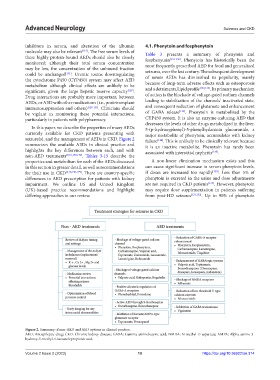
            seizure(s), and the management of AEDs in CKD. Figure 2   failure [134] . This is unlikely to be clinically relevant because
            summarizes the available AEDs in clinical practice and   it is an inactive metabolite. Phenytoin has rarely been
            highlights  the  key  differences  between  each,  and  with   associated with interstitial nephritis [135] .
            non-AED treatments [9,16,130-179] .  Tables  3-15  describe the
            properties and metabolism for each of the AEDs discussed   A non-linear elimination mechanism exists and this
            in this section in greater detail, as well as recommendations   can cause significant increase in serum phenytoin levels,
            for their use in CKD [9,16,130-179] . There are country-specific   if doses are increased too rapidly [135] . Less than 5% of
            differences in AED prescription for patients with kidney   phenytoin is excreted in the urine and dose adjustments
            impairment. We outline US and United  Kingdom      are not required in CKD patients [135] . However, phenytoin
            (UK)-based practice recommendations and highlight   may require dose supplementation in patients suffering
            differing approaches in our review.                from post-HD seizures [131,135] . Up to 90% of phenytoin


            Figure 2. Summary of non-AED and AED options in clinical practice.
            AED: Antiepileptic drug; CKD: Chronic kidney disease; GABA: Gamma-aminobutyric acid; NMDA: N-methyl-D-aspartate; AMPA: Alpha-amino-3-
            hydroxy-5-methyl-4-isoxazolepropionic acid.


                                                                                       https://doi.org/10.36922/an.314
            V
            Volume 2 Issue 2 (2023) olume 2 Issue 2 (2023)   10                        https://doi.org/10.36922/an.314
                                                            10

