


Page 38 - AN-2-2
P. 38
Advanced Neurology                                                                  Seizures and CKD


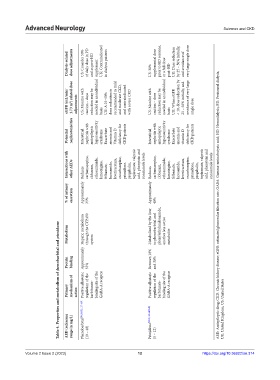
                              Dialysis‑related   dose adjustments  US: Consider 50%   of daily dose in PD   and as post-HD   supplement  UK: Contraindicated   in dialysis patients  US: 30%   supplemental dose   prior to HD sessions,   or a full dose   post-HD  UK: Dose reduction   by 25 – 50% initially,   and avoidance of   very large single dose


                              eGFR (mL/min/   1.73 m 2 ) related dose   adjustments  US: Monitor with   caution – dose   reduction may be   needed in an individual   basis  UK: A 25–50%   dose reduction is   recommended in mild   and moderate CKD,   and contraindicated   with severe CKD   US: Monitor with   caution – dose   reduction may be   needed in an individual   basis  UK: When eGFR    < 10, dose reduction by   25 – 50% initially, and   avoidance of very large   sin


                              Potential   nephrotoxicities  Interstitial   nephritis with   antiepileptic   hypersensitivity   syndrome  Exacerbate   anemia and   Vitamin D   deficiency for   CKD patients  Interstitial   nephritis with   antiepileptic   hypersensitivity   syndrome  Exacerbate   anemia and   vitamin D   deficiency for   CKD patients


                              Interactions with   other AEDs  Reduces   carbamazepine,   clobazam,   ethosuximide,   lamotrigine,   felbamate,   lacosamide,   levetiracetam,   oxcarbazepine,   primidone,   pregabalin,   topiramate, valproic   acid, phenytoin and   zonisamide levels  Reduces   carbamazepine,   clobazam,   ethosuximide,   lamotrigine,   felbamate,   lacosamide,   levetiracetam,   oxcarbazepine,   primidone,   pregabalin,   topiramate, valproic   acid, pheny


                              % of urinary   excretion  Approximately   25%  Approximately   40%  AED: Antiepileptic drug; CKD: Chronic kidney disease; eGFR: estimated glomerular filtration rate; GABA: Gamma-aminobutyric acid; HD: Hemodialysis; PD: Peritoneal dialysis;


                          Table 4. Properties and metabolism of ;henobarbital and ;rimidone
                              Metabolism  Hepatic metabolism   through the CYP450   system  Metabolized by the liver   to phenobarbital and   phenylethylmalonamide,   another less active   metabolite


                              Protein   binding  Approximately   55%  Between 10%   and 30%


                              Primary   mechanism of   action  Positive allosteric   regulation of the   barbiturate-   binding site of the   GABA-A receptor  Positive allosteric   regulation of the   barbiturate-   binding site of the   GABA-A receptor


                              AED (reference    range in mg/L)  Phenobarbital [9,130,135,137-139]  (10 – 40)  Primidone [9,130,131,140,141]  (5 – 12)  UK: United Kingdom; US: United States


                                                            12
                                                                                       https://doi.org/10.36922/an.314
            Volume 2 Issue 2 (2023) olume 2 Issue 2 (2023)   12                        https://doi.org/10.36922/an.314
            V

