


Page 75 - AN-2-2
P. 75
Advanced Neurology                                                    Role of immunosuppressants in autism


            is adversely influenced by AZA. The author demonstrated   7. Differentiating rapamycin and
            that AZA inhibits the expression of PPAR, the master   azathioprine in the treatment of ASD
            adipogenic regulator, in FAPs isolated from wild-type and
            mdx mice, thereby decreasing their adipogenic potential.   Rapamycin and AZA are two different drugs that have been
            In addition, this is associated with reduced activity of the   studied for their potential use in treating ASD, but they
            AKT-mTOR axis. This study provides evidence that the   work through different mechanisms and have different
            AZA negatively regulates the adipogenic differentiation   side effect profiles. Rapamycin is an mTOR inhibitor
            of wild-type and mdx FAPs by preventing them from   that can improve social behavior and synaptic function
            reaching a terminally differentiated state. This negative   in animal models of ASD. The drug has been studied in
            modulation of PPAR by AZA is associated with the   clinical trials in individuals with ASD, with some studies
            reduced activation of AKT-mTOR signaling. Reggio et al.   showing positive results in improving social behavior and
            demonstrated that impaired PPAR expression correlates   reducing repetitive behaviors [141] . However, the drug is
            with blunted activation of the PI3K/AKT/mTOR axis,   also associated with significant side effects, including an
            indicating that azathioprine can inhibit the mTOR   increased risk of infections, metabolic disturbances, and
            pathway as well as mTORC1, which has been upregulated   gastrointestinal symptoms. Azathioprine, on the other
            in autism, and this elevation will be responsible for   hand, is an immunosuppressant that has been studied
            further elevation of NK cells, [110,132,133,138] . Azathioprine   for its potential use in treating gastrointestinal symptoms
            acts against IBD through the downregulation of     commonly seen in individuals with ASD [142] . The drug
            mTORC1  [139] . According to Green et al., AZA can inhibit   works  by  suppressing  the  immune  system,  which  is
            the NK cell [140] . Based on the above information, we know   thought to play a role in the pathogenesis of gastrointestinal
            that AZA is an inhibitor of NK cells and can also inhibit   symptoms in ASD. While some studies have suggested
            the  AKT/mTOR  pathway through PPARγ.  In  addition,   that AZA may be effective in improving gastrointestinal
            it can limit FAP activity. This suggests that azathioprine   symptoms  in  individuals  with  ASD, the  drug  is  also
            could be a potential treatment for autism, as it may help   associated with significant side effects, including an
            to reduce the activation of mTORc1, which can increase   increased risk of infections and liver toxicity [143] . Further
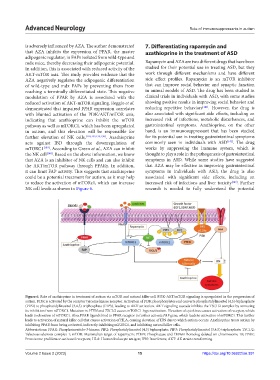
            NK cell levels as shown in Figure 6.               research is needed to fully understand the potential


            Figure 6. Role of azathioprine in treatment of autism via mTOR and natural killer cell. PI3K-AKT/mTOR signaling is upregulated in the progression of
            autism. PI3K is activated by the receptor tyrosine kinase receptor. Activation of PI3K phosphorylates and converts phosphatidylinositol (4,5)-biphosphate
            (PIP2) to phosphatidylinositol (3,4,5)-triphosphate (PIP3), leading to AKT activation. AKT signaling cascade inhibits the TSC1/2 complex by removing
            its inhibition from mTORC1. Mutation in PTEN and TSC1/2 causes mTORC1 hyperactivation. Elevation of cytokines causes activation of receptor, which
            leads to elevation of mTORC1. Also, PPAR ligands bind to PPAR receptor to further activate FAP gene, which leads to activation of mTORC1. This further
            leads to activation of natural killer cell that causes activation of HLA, causing elevation of IFN due to which autism occurs. Azathioprine treats autism by
            inhibiting PPAR from being activated, indirectly inhibiting mTORC1, and inhibiting natural killer cells.
            Abbreviations: PPAR: Phosphoinositide-3-kinase; PIP2: Phosphatidylinositol (4,5) biphosphate; PIP3: Phosphatidylinositol (3,4,5) triphosphate; TSC1/2:
            Tuberous sclerosis complex 1; mTOR: Mammalian target of rapamycin; PTEN: Phosphatase and TENsin homolog deleted on chromosome 10; PPAR:
            Peroxisome proliferator-activated receptors; HLA: Human leukocyte antigen; IFN: Interferons; AKT: AK strain transforming.


            Volume 2 Issue 2 (2023)                         15                         https://doi.org/10.36922/an.391

