


Page 76 - AN-2-2
P. 76
Advanced Neurology                                                    Role of immunosuppressants in autism


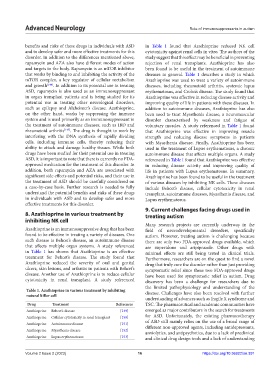
            benefits and risks of these drugs in individuals with ASD   in  Table  1  found  that  Azathioprine reduced  NK cell
            and to develop safer and more effective treatments for this   cytotoxicity against renal cells in vitro. The authors of the
            disorder. In addition to the differences mentioned above,   study suggest that this effect may be beneficial in preventing
            rapamycin and AZA also have different modes of action   rejection of renal transplants. Azathioprine has also
            and targets in the body. Rapamycin is an mTOR inhibitor   been found to be useful in the treatment of autoimmune
            that works by binding to and inhibiting the activity of the   diseases in general.  Table 1 describes a study in which
            mTOR complex, a key regulator of cellular metabolism   Azathioprine was used to treat a variety of autoimmune
            and growth [144] . In addition to its potential use in treating   diseases, including rheumatoid arthritis, systemic lupus
            ASD, rapamycin  is also used as an immunosuppressant   erythematosus, and Crohn’s disease. The study found that
            in  organ  transplant  patients  and  is  being  studied  for  its   Azathioprine was effective in reducing disease activity and
            potential use  in treating other  neurological  disorders,   improving quality of life in patients with these diseases. In
            such as epilepsy and Alzheimer’s disease. Azathioprine,   addition to autoimmune diseases, Azathioprine has also
            on the other hand, works by suppressing the immune   been used to treat Myasthenia disease, a neuromuscular
            system and is used primarily as an immunosuppressant in   disorder characterized by weakness and fatigue of
            the treatment of autoimmune diseases, such as IBD and   voluntary muscles. A  study referenced in  Table 1 found
            rheumatoid arthritis [145] . The drug is thought to work by   that Azathioprine was effective in improving muscle
            interfering with the DNA synthesis of rapidly dividing   strength and reducing disease symptoms in patients
            cells, including immune cells, thereby reducing their   with Myasthenia disease. Finally, Azathioprine has been
            ability to attack and damage healthy tissues. While both   used in the treatment of Lupus erythematosus, a chronic
            drugs have been studied for their potential use in treating   autoimmune disease that affects multiple organs. A study
            ASD, it is important to note that there is currently no FDA-  referenced in Table 1 found that Azathioprine was effective
            approved medication for the treatment of this disorder. In   in reducing disease activity and improving quality of
            addition, both rapamycin and AZA are associated with   life in patients with Lupus erythematosus. In summary,
            significant side effects and potential risks, and their use in   Azathioprine has been found to be useful in the treatment
            the treatment of ASD should be carefully considered on   of various diseases by inhibiting NK cells. These diseases
            a case-by-case basis. Further research is needed to fully   include Behcet’s disease, cellular cytotoxicity in renal
            understand the potential benefits and risks of these drugs   transplant, autoimmune diseases, Myasthenia disease, and
            in individuals with ASD and to develop safer and more   Lupus erythematosus.
            effective treatments for this disorder.
                                                               9. Current challenges facing drugs used in
            8. Azathioprine in various treatment by            treating autism
            inhibiting NK cell
                                                               Many research projects are currently underway in the
            Azathioprine is an immunosuppressive drug that has been   field of neurodevelopmental disorders, specifically
            found to be effective in treating a variety of diseases. One   autism. However, treating autism is challenging because
            such disease is Behcet’s disease, an autoimmune disease   there are only two FDA-approved drugs available, which
            that affects multiple organ systems. A  study referenced   are risperidone and aripiprazole. Other drugs with
            in  Table 1 has shown that Azathioprine is an effective   minimal effects are still being tested in clinical trials.
            treatment for Behcet’s disease. The study found that   Furthermore, researchers are on the quest to find a novel
            Azathioprine  reduced  the  severity  of  oral  and  genital   drug that truly cure the disorder rather than just providing
            ulcers, skin lesions, and arthritis in patients with Behcet’s   symptomatic relief since these two FDA-approved drugs
            disease. Another use of Azathioprine is to reduce cellular   have been used for symptomatic relief in autism. Drug
            cytotoxicity in renal transplant. A  study referenced   discovery has been a challenge for researchers due to
                                                               the limited pathophysiology and understanding of the
            Table 1. Azathioprine in various treatment by inhibiting
            natural killer cell                                disease. Challenges have also been resolved with further
                                                               understanding of advances such as fragile X syndrome and
             Drug      Treatment                  References   TSC. The pharmaceutical and academic communities have
            Azathioprine  Behcet’s disease          [149]      emerged as major contributors in the search for treatments
            Azathioprine  Cellular cytotoxicity in renal transplant  [150]  for ASD. Unfortunately, the existing pharmacotherapy
            Azathioprine  Autoimmune disease        [151]      of ASD still mainly relies on the use of a broad range of
                                                               different non-approved agents, including antidepressants,
            Azathioprine  Myasthenia disease        [152]      anxiolytics, and antipsychotics, due to a lack of preclinical
            Azathioprine  Lupus erythematosus       [153]      and clinical drug design tools and a lack of understanding


            Volume 2 Issue 2 (2023)                         16                         https://doi.org/10.36922/an.391

