


Page 40 - AN-2-4
P. 40
Advanced Neurology                                         Evoked potential response in parkinsonian syndromes


            Table 4. (Continued)
            Spearman's correlation in IPD (n=50) and APS (n=50)  IPD‑Duration  IPD‑Modified Hoehn   APS‑Duration  APS‑Modified Hoehn
                                                                 and Yahr Staging               and Yahr Staging
            N20R_SSEP
             Correlation coefficient                   0.254         0.313*         0.384**        0.315*
             Sig. (2-tailed)                           0.075         0.027           0.006          0.026
            N13-N20R_SSEP
             Correlation coefficient                   0.170          0.105          0.210          0.140
             Sig. (2-tailed)                           0.237          0.468          0.143          0.333
            N9L_SSEP
             Correlation coefficient                   0.143          0.204         −0.005          0.175
             Sig. (2-tailed)                           0.322          0.156          0.972          0.224
            N13L_SSEP
             Correlation coefficient                   0.204         0.311*         0.331*         0.358*
             Sig. (2-tailed)                           0.155         0.028           0.019          0.011
            N20L_SSEP
             Correlation coefficient                   0.255         0.327*         0.320*         0.309*
             Sig. (2-tailed)                           0.074         0.020           0.024          0.029
            N13-N20L_SSEP
             Correlation coefficient                   0.193          0.148          0.179          0.108
             Sig. (2-tailed)                           0.179          0.306          0.212          0.455
            Note: Statistically significant values are in bold font.
            Abbreviations: IPD: Idiopathic Parkinson’s disease; APS: Atypical parkinsonian syndromes; L: Left; R: Right.

            3.7. SSEP in CBD                                   3.9. Correlation with disease severity
            In patients with CBD on the apraxic side, the latency of N13,   Modified Hoehn and Yahr staging was performed to
            N20, and central sensory conduction time (N13 – N20)   determine  disease  severity  in  IPD  patients.  The  similar
            was increased compared to the non-apraxic side. The mean   staging procedure was also applied to the APS group. We
            values of N13, N20, and CCT (msec) are 14.596 ± 1.0 vs.   found the VEP latency of N75, P100, and N145 having
            13.77 ± 0.9, 21.74 ± 1.0 vs. 20.33 ± 0.9, and 7.144 ± 0.9 vs.   a good positive correlation and the V/I amplitude ratio
            6.56 ± 0.8, respectively (P < 0.05).               having a good negative correlation bilaterally with the
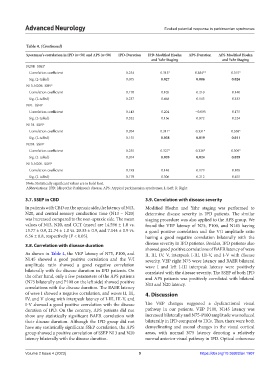
            3.8. Correlation with disease duration             disease severity in IPD patients. Besides, IPD patients also
                                                               showed good positive correlations of BAER latency of wave
            As shown in Table 4, the VEP latency of N75, P100, and   II, III, IV, V, interpeak I-III, III-V, and I-V with disease
            N145 showed a good positive correlation and the V/I   severity. VEP right N75 wave latency and BAER bilateral
            amplitude ratio showed a good negative correlation   wave I and left I-III interpeak latency were positively
            bilaterally with the disease duration in IPD patients. On   correlated with the disease severity. The SSEP of both IPD
            the other hand, only a few parameters of the APS patients   and APS patients was positively correlated with bilateral
            (N75 bilaterally and P100 on the left side) showed positive   N13 and N20 latency.
            correlations with the disease duration. The BAER latency
            of wave I showed a negative correlation, and waves II, III,   4. Discussion
            IV, and V along with interpeak latency of I-III, III-V, and
            I-V showed a good positive correlation with the disease   The VEP changes suggested a dysfunctional visual
            duration of IPD. On the contrary, APS patients did not   pathway in our patients. VEP P100, N145 latency was
            show any statistically significant BAER correlation with   increased bilaterally and N75-P100 amplitude was reduced
            their disease duration. Although the IPD group did not   bilaterally in IPD compared to HCs. Thus, there were both
            have any statistically significant SSEP correlation, the APS   demyelinating and axonal changes in the visual cortical
            group showed a positive correlation of SSEP N13 and N20   areas, with normal N75 latency denoting a relatively
            latency bilaterally with the disease duration.     normal anterior visual pathway in IPD. Optical coherence


            Volume 2 Issue 4 (2023)                         9                         https://doi.org/10.36922/an.1907

