


Page 35 - AN-2-4
P. 35
Advanced Neurology                                         Evoked potential response in parkinsonian syndromes


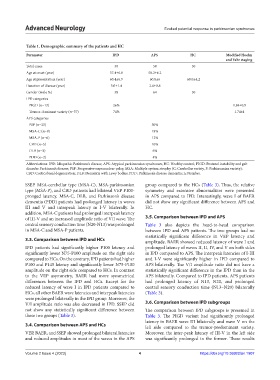
            Table 1. Demographic summary of the patients and HC
            Parameter                            IPD             APS              HC             Modified Hoehn
                                                                                                 and Yahr staging
            Total cases                           50              50               50
            Age at onset (year)                 57.4±6.8        58.2±6.2
            Age at presentation (year)          60.4±6.9         60.8±6          60.0±4.2
            Duration of disease (year)          3.0±1.4          2.6±0.8
            Gender (male %)                       58              64               50
            IPD categories
             PIGD (n=13)                         26%                                                1.84±0.9
             Tremor-dominant variety (n=37)      74%                                                 1.74±1
            APS categories
             PSP (n=25)                                           50%
             MSA-C (n=9)                                          18%
             MSA-P (n=6)                                          12%
             CBD (n=5)                                            10%
             DLB (n=3)                                            6%
             PDD (n=2)                                            4%
            Abbreviations: IPD: Idiopathic Parkinson’s disease; APS: Atypical parkinsonian syndromes; HC: Healthy control; PIGD: Postural instability and gait
            disorder Parkinson’s disease; PSP: Progressive supranuclear palsy; MSA: Multiple system atrophy (C: Cerebellar variety, P: Parkinsonian variety);
            CBD: Corticobasal degeneration; DLB: Dementia with Lewy bodies; PDD: Parkinson’s disease dementia; n: Number.

            SSEP. MSA-cerebellar type (MSA-C), MSA-parkinsonian   group compared to the HCs (Table 3). Thus, the relative
            type (MSA-P), and CBD patients had bilateral VEP P100-  symmetry and extensive abnormalities were presented
            pronged latency. MSA-C, DLB, and Parkinson’s disease   in APS compared to IPD. Interestingly, wave I of BAER
            dementia (PDD) patients had prolonged latency in waves   did not show any significant difference between APS and
            III  and  V  and  interpeak  latency  in  I-V  bilaterally.  In   HC.
            addition, MSA-C patients had prolonged interpeak latency
            of III-V and an increased amplitude ratio of V/I wave. The   3.5. Comparison between IPD and APS
            central sensory conduction time (N20-N13) was prolonged   Table 3 also depicts the head-to-head comparison
            in MSA-C and MSA-P patients.                       between IPD and APS patients. The two groups had no
                                                               statistically significant difference in VEP latency and
            3.3. Comparison between IPD and HCs                amplitude. BAER showed reduced latency of wave I and
            IPD patients had significantly higher P100 latency and   prolonged latency of waves II, II, IV, and V on both sides
            significantly lower N75-P100 amplitude on the right side   in IPD compared to APS. The interpeak latencies of I-III
            compared to HCs. On the contrary, IPD patients had higher   and I-V were significantly higher in IPD compared to
            P100 and P145 latency and significantly lower N75-P100   APS bilaterally. The V/I amplitude ratio did not have a
            amplitude on the right side compared to HCs. In contrast   statistically significant difference in the IPD than in the
            to the VEP asymmetry, BAER had more symmetrical    APS bilaterally. Compared to IPD patients, APS patients
            differences between the IPD and HCs. Except for the   had prolonged latency of N13, N20, and prolonged
            reduced latency of wave I in IPD patients compared to   central sensory conduction time (N13–N20) bilaterally
            HCs, all other BAER wave latencies and interpeak latencies   (Table 3).
            were prolonged bilaterally in the IPD group. Moreover, the
            V/I amplitude ratio was also decreased in IPD. SSEP did   3.6. Comparison between IPD subgroups
            not show any statistically significant difference between   The comparison between IPD subgroups is presented in
            these two groups (Table 3).                        Table  3.  The  PIGD  variant  had  significantly  prolonged
                                                               latency in BAER wave III bilaterally and wave V on the
            3.4. Comparison between APS and HCs                left  side  compared  to the  tremor-predominant variety.
            VEP, BAER, and SSEP showed prolonged bilateral latencies   Moreover, the inter-peak latency of III-V in the left side
            and reduced amplitudes in most of the waves in the APS   was significantly prolonged in the former. These results


            Volume 2 Issue 4 (2023)                         4                         https://doi.org/10.36922/an.1907

