


Page 34 - AN-2-4
P. 34
Advanced Neurology                                         Evoked potential response in parkinsonian syndromes


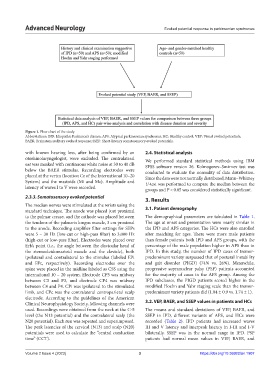
            Figure 1. Flow chart of the study.
            Abbreviations: IPD: Idiopathic Parkinson’s disease; APS: Atypical parkinsonian syndromes; HC: Healthy control; VEP: Visual evoked potentials;
            BAER: Brainstem auditory evoked response; SSEP: Short-latency somatosensory evoked potentials.

            with  known  hearing  loss,  after  being  confirmed  by an   2.4. Statistical analysis
            otorhinolaryngologist, were excluded. The  contralateral   We performed standard statistical methods using IBM
            ear was masked with continuous white noise at 30 to 40 dB   SPSS  software  version  26.  Kolmogorov–Smirnov  test  was
            below the BAER stimulus. Recording electrodes were   conducted to evaluate the normality of data distribution.
            placed at the vertex (location Cz of the International 10–20   Since the data were not normally distributed, Mann–Whitney
            System) and the mastoids (Mi and Mc). Amplitude and   U-test was performed to compare the median between the
            latency of waves I to V were recorded.             groups and P < 0.05 was considered statistically significant.

            2.3.3. Somatosensory evoked potential              3. Results
            The median nerves were stimulated at the wrists using the
            standard technique. The anode was placed just proximal   3.1. Patient demography
            to the palmar crease, and the cathode was placed between   The demographical parameters are tabulated in  Table 1.
            the tendons of the palmaris longus muscle, 3 cm proximal   The age at onset and presentation were nearly similar in
            to the anode. Recording amplifier filter settings for SEPs   the IPD and APS categories. The HCs were also enrolled
            were 5 – 30 Hz (low-cut or high-pass filter) to 3,000 Hz   after matching for ages. There were more male patients
            (high-cut or low-pass filter). Electrodes were placed over   than female patients both IPD and APS groups, with the
            Erb’s point (i.e., the angle between the clavicular head of   percentage of the male population higher in APS than in
            the sternocleidomastoid muscle and the clavicle), both   IPD. In this study, the number of IPD cases of tremor-
            ipsilateral and contralateral to the stimulus (labeled EPi   predominant variety surpassed that of postural instability
            and EPc, respectively). Recording electrodes over the   and gait disorder (PIGD) (74% vs. 26%). Meanwhile,
            spine were placed in the midline labeled as C5S using the   progressive supranuclear palsy (PSP) patients accounted
            international 10 – 20 system. Electrode CP3 was midway   for  the  majority  of  cases  in  the  APS  group.  Among  the
            between C3 and P3, and electrode CP4 was midway    IPD subclasses, the PIGD patients scored higher in the
            between C4 and P4. CPi was ipsilateral to the stimulated   modified Hoehn and Yahr staging scale than the tremor-
            limb,  and  CPc  was  the  contralateral  centroparietal  scalp   predominant variety patients did (1.84 ± 0.9 vs. 1.74 ± 1).
            electrode.  According  to  the  guidelines  of  the  American
            Clinical Neurophysiology Society, following channels were   3.2. VEP, BAER, and SSEP values in patients and HCs
            used. Recordings were obtained from the neck at the C-5   The  means  and  standard  deviations  of VEP, BAER,  and
            level (the N13 potential) and the contralateral scalp (the   SSEP in IPD, different variants of APS, and HCs were
            N20 potential). Each run was repeated and superimposed.   recorded (Table 2). IPD patients had increased waves
            The peak latencies of the cervical (N13) and scalp (N20)   III and V latency and interpeak latency in I-III and I-V
            potentials were used to calculate the “central conduction   bilaterally. SSEP was in the normal range in IPD. PSP
            time” (CCT).                                       patients had  normal  mean values  in  VEP, BAER,  and


            Volume 2 Issue 4 (2023)                         3                         https://doi.org/10.36922/an.1907

