


Page 51 - AN-2-4
P. 51
Advanced Neurology                                                         Genomic insights into Alzheimer


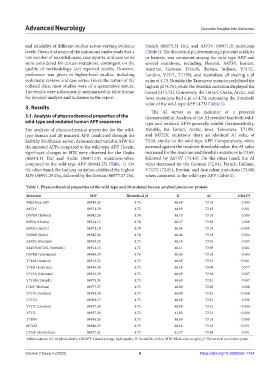
            and reliability of different studies across varying evidence   French (86975.31 Da), and A673V (86971.3) mutations
            levels. Given that many of the mutations under study had a   (Table 1). The theoretical pI, determining a protein’s acidicity
            low number of recorded cases, case reports, and case series   or basicity, was consistent among the wild-type APP and
            were considered for certain mutations, contingent on the   several mutations, including Flemish, A673V, Iranian,
            quality of methodology and reported results. However,   Austrian, German, French, Iberian, Indiana, V717G,
            preference was given to higher-level studies, including   London, V717L, T719N, and Australian, all sharing a pI
            systematic reviews and case series. Given the nature of the   value of 4.73. Notably, the Taiwanese mutation exhibited the
            collated data, most studies were of a quantitative nature.   highest pI (4.76), while the Swedish mutation displayed the
            The results were subsequently summarized in table format   lowest pI (4.72). Conversely, the Tottori, Osaka, Arctic, and
            for detailed analysis and inclusion in the report.  Iowa mutations had a pI of 4.74, surpassing the threshold
                                                               value of the wild-type APP (4.73) (Table 1).
            3. Results
                                                                 The AI serves as an indicator of a protein’s
            3.1. Analysis of physicochemical properties of the   thermostability. Analysis of the AI revealed that both wild-
            wild-type and mutated human APP sequences          type and mutated APPs generally exhibit thermostability.
            The  analysis  of  physicochemical  properties  for  the  wild-  Notably,  the  Tottori,  Arctic,  Iowa,  Taiwanese,  T719N,
            type human and 20 mutated APP, conducted through the   and M722K mutations share an identical AI value of
            ExPASy ProtParam server, demonstrated variable MW for   73.18, similar to the wild-type APP. Comparatively, when
            the mutated APPs compared to the wild-type APP. Herein,   assessed against the resultant threshold value, the AI value
            significant changes in MW were observed for the Osaka   increased for the Austrian and Swedish mutations to 73.69,
            (86814.13 Da) and Arctic (86871.19) mutations when   followed by A673V (73.43). On the other hand, the AI

            compared to the wild-type APP (86943.25) (Table 1). On   value decreased for the German (72.94), French, Indiana,
            the other hand, the Indiana mutation exhibited the highest   V717G (72.81), Iberian, and Australian mutations (72.68)
            MW (86991.29 Da), followed by the Iberian (86977.27 Da),   when compared to the wild-type APP (Table 1).

            Table 1. Physicochemical properties of the wild‑type and 20 mutated human amyloid precursor protein
            Mutation                   MW              Theoretical pI       II           AI           GRAVY
            Wild-type APP             86943.25            4.73             40.69        73.18          −0.584
            A673V                     86971.30            4.73             40.69        73.43          −0.581
            D678N (Tottori)           86942.26            4.74             40.75        73.18          −0.584
            E693∆ (Osaka)             86814.13            4.74             40.37        73.28          −0.580
            E693G (Arctic)            86871.19            4.74             40.44        73.18          −0.580
            D694N (Iowa)              86942.26            4.74             40.44        73.18          −0.584
            A692G (Flemish)           86929.22            4.73             40.59        73.05          −0.587
            KM670/671NL (Swedish)     86911.15            4.72             40.31        73.69          −0.581
            D678H (Taiwanese)         86965.30            4.76             40.44        73.18          −0.584
            T714A (Iranian)           86913.22            4.73             40.69        73.31          −0.581
            T714I (Austrian)          86955.30            4.73             40.58        73.69          −0.577
            V715A (German)            86915.20            4.73             40.69        72.94          −0.587
            V715M (French)            86975.31            4.73             40.69        72.81          −0.587
            I716F (Iberian)           86977.27            4.73             40.80        72.68          −0.586
            V717F (Indiana)           86991.29            4.73             40.80        72.81          −0.586
            V717G                     86901.17            4.73             40.69        72.81          −0.590
            V717I (London)            86957.28            4.73             40.80        73.31          −0.584
            V717L                     86957.28            4.73             41.05        73.31          −0.584
            T719N                     86956.25            4.73             40.69        73.18          −0.588
            M722K                     86940.23            4.75             40.54        73.18          −0.591
            L723P (Australian)        86927.21            4.73             41.37        72.68          −0.591
            Abbreviations: AI: Aliphatic index; GRAVY: Grand average hydropathy; II: Instability index; MW: Molecular weight; pI: Theoretical isoelectric point.


            Volume 2 Issue 4 (2023)                         6                         https://doi.org/10.36922/an.1734

