


Page 55 - AN-2-4
P. 55
Advanced Neurology                                                         Genomic insights into Alzheimer


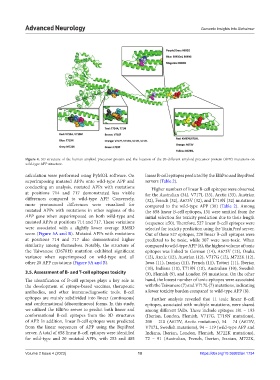
            Figure 4. 3D structure of the human amyloid precursor protein and the location of the 20 different amyloid precursor protein (APP) mutations on
            wild-type APP structure.

            calculation were performed using PyMOL software. On   linear B-cell epitopes predicted by the ElliPro and BepiPred
            superimposing mutated APPs onto wild-type  APP and   servers (Table 2).
            conducting an analysis, mutated APPs with mutations   Higher numbers of linear B-cell epitopes were observed
            at positions 714 and 717 demonstrated less visible   for the Australian (34), V717L (33), Arctic (33), Austrian
            differences compared to wild-type  APP. Conversely,   (32), French (32), A673V (32), and T719N (32) mutations
            more pronounced differences were visualized for    compared to the wild-type  APP (30) (Table 2). Among
            mutated APPs with mutations in other regions of the   the 658 linear B-cell epitopes, 131 were omitted from the
            APP gene when superimposed on both wild-type and   initial selection for toxicity prediction due to their length
            mutated APPs at positions 714 and 717. These variations   (sequence ≥50). Therefore, 527 linear B-cell epitopes were
            were associated with a slightly lower average RMSD   selected for toxicity prediction using the ToxinPred server.
            score (Figure 5A and B). Mutated APPs with mutations   Out of these 527 epitopes, 220 linear B-cell epitopes were
            at positions 714 and 717 also demonstrated higher   predicted to be toxic, while 307 were non-toxic. When
            similarity among themselves. Notably, the structure of   compared to wild-type APP (8), the highest volume of toxic
            the Taiwanese (D678H) mutation exhibited significant   epitopes was linked to German (14), A673V (13), Osaka
            variance when superimposed on wild-type and all    (12), Arctic (12), Austrian (12), V717G (12), M722K (12),
            other 20 APP mutations (Figure 5A and B).          Iowa (11), Iranian (11), French (11), Tottori (11), Iberian
                                                               (10), Indiana (10), T719N (10), Australian (10), Swedish
            3.5. Assessment of B- and T-cell epitopes toxicity  (9), Flemish (9), and London (9) mutations. On the other
            The identification of B-cell epitopes plays a key role in   hand, the lowest number of toxic epitopes were associated
            the development of epitope-based vaccines, therapeutic   with the Taiwanese (7) and V717L (7) mutations, indicating
            antibodies,  and  other  immunodiagnostic  tools.  B-cell   a lower toxicity burden compared to wild-type APP (8).
            epitopes are mainly subdivided into linear (continuous)   Further analysis revealed that 11 toxic linear B-cell
            and conformational (discontinuous) forms. In this study,   epitopes, associated with multiple mutations, were shared
            we utilized the ElliPro server to predict both linear and   among different fADs. These include epitopes 181 – 193
            conformational B-cell epitopes from the 3D structures   (Iberian, London, Flemish, V717G, T719N mutations),
            of APP. In addition, linear B-cell epitopes were predicted   200 – 210 (A673V, Arctic mutations), 54 – 74 (A673V,
            from  the  linear  sequences  of  APP  using  the BepiPred   V717L, Swedish mutations), 94 – 119 (wild-type APP and
            server. A total of 658 linear B-cell epitopes were identified   Indiana, Iberian, London, Flemish, M722K mutations),
            for wild-type and 20 mutated APPs, with 253 and 405   72 – 91 (Australian, French, Iberian, Iranian, M722K,


            Volume 2 Issue 4 (2023)                         10                        https://doi.org/10.36922/an.1734

