


Page 53 - AN-2-4
P. 53
Advanced Neurology                                                         Genomic insights into Alzheimer


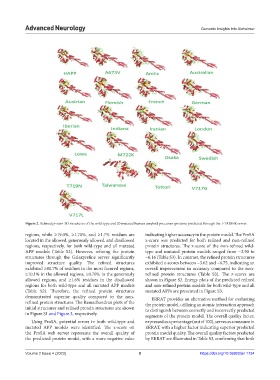
            Figure 2. Refined protein 3D structures of the wild-type and 20 mutated human amyloid precursor proteins predicted through the I-TASSER server.

            regions, while ≥19.0%, ≥1.70%, and ≥1.7% residues are   indicating higher accuracy in the protein model. The ProSA
            located in the allowed, generously allowed, and disallowed   z-score was predicted for both refined and non-refined
            regions, respectively, for both wild-type and all mutated   protein structures. The z-score of the non-refined wild-
            APP models (Table S2). However, refining the protein   type and mutated protein models ranged from −2.50 to
            structures through the Galaxyrefine server significantly   −6.16 (Table S3). In contrast, the refined protein structures
            improved structure quality. The refined structures   exhibited z-scores between −3.62 and −6.75, indicating an
            exhibited ≥80.7% of residues in the most favored regions,   overall improvement in accuracy compared to the non-
            ≥10.1% in the allowed regions, ≥0.70% in the generously   refined protein  structures (Table S3). The z-scores  are
            allowed regions, and ≥1.6% residues in the disallowed   shown in Figure S2. Energy plots of the predicted refined
            regions for both wild-type and all mutated APP models   and non-refined protein models for both wild-type and all
            (Table S2). Therefore, the refined protein structures   mutated APPs are presented in Figure S3.
            demonstrated superior quality compared to the non-   ERRAT provides an alternative method for evaluating
            refined protein structures. The Ramachandran plots of the   the protein model, utilizing an atomic interaction approach
            initial structures and refined protein structures are shown   to distinguish between correctly and incorrectly predicted
            in Figure S1 and Figure 3, respectively.           segments of the protein model. The overall quality factor,

              Using ProSA, potential errors in both wild-type and   expressed as a percentage (out of 100), serves as a measure in
            mutated APP  models were identified. The z-score on   ERRAT, with a higher factor indicating superior predicted
            the  ProSA  web server  represents  the  overall  quality of   protein model quality. The overall quality factors predicted
            the predicted protein model, with a more negative value   by ERRAT are illustrated in Table S3, confirming that both


            Volume 2 Issue 4 (2023)                         8                         https://doi.org/10.36922/an.1734

