


Page 56 - AN-2-4
P. 56
Advanced Neurology                                                         Genomic insights into Alzheimer


                         A


                         B


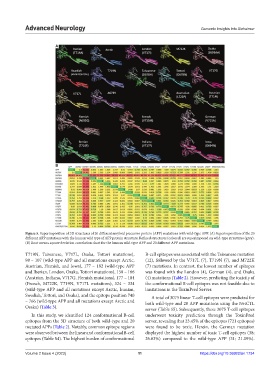
            Figure 5. Superimposition of 3D structures of 20 different amyloid precursor protein (APP) mutations with wild-type APP. (A) Superimposition of the 20
            different APP mutations with the human wild type of APP protein structure. Refined structures (colored) are superimposed on wild-type structures (grey).
            (B) Root means square deviation correlation chart for the human wild-type APP and 20 different APP mutations.

            T719N, Taiwanese, V717L, Osaka, Tottori mutations),   B-cell epitopes was associated with the Taiwanese mutation
            98 – 107 (wild-type APP and all mutations except Arctic,   (12), followed by the V717L (7), T719N (7), and M722K
            Austrian, Flemish, and Iowa), 177 – 182 (wild-type APP   (7) mutations. In contrast, the lowest number of epitopes
            and Iberian, London, Osaka, Tottori mutations), 158 – 166   was found with the London (4), German (4), and Osaka
            (Austrian, Indiana, V717G, Flemish mutations), 177 – 184   (4) mutations (Table 2). However, predicting the toxicity of
            (French, M722K, T719N, V717L mutations),  324 – 334   the conformational B-cell epitopes was not feasible due to
            (wild-type APP and all mutations except Arctic, Iranian,   limitations in the ToxinPred Server.
            Swedish, Tottori, and Osaka), and the epitope position 740   A total of 3075 linear T-cell epitopes were predicted for
            – 766 (wild-type APP and all mutations except Arctic and   both wild-type and 20 APP mutations using the NetCTL
            Osaka) (Table 3).                                  server (Table S5). Subsequently, these 3075 T-cell epitopes
              In this study, we identified 124 conformational B-cell   underwent  toxicity  prediction  through  the  ToxinPred
            epitopes from the 3D structure of both wild-type and 20   server, revealing that 23.45% of the epitopes (721 epitopes)
            mutated APPs (Table 2). Notably, common epitope regions   were found to be toxic. Herein, the German mutation
            were observed between the linear and conformational B-cell   displayed the highest number of toxic T-cell epitopes (38;
            epitopes (Table S4). The highest burden of conformational   26.03%) compared to the wild-type  APP (31; 21.09%).


            Volume 2 Issue 4 (2023)                         11                        https://doi.org/10.36922/an.1734

