


Page 78 - AN-3-4
P. 78
Advanced Neurology                                           SARS-CoV-2 in age-associated neurodegeneration


              Systematic analyses of various studies and case reports   and cells in the gastrointestinal (GI) tract. 48,49  Study has
            suggest that SARS-CoV-2 not only alters brain architecture   demonstrated that among respiratory viruses, SARS-CoV-2
            but also causes cognitive impairment in individuals with   exhibits the highest affinity for the ACE2 receptor.  This
                                                                                                        50
            mild or acute COVID-19 infection.  Previous reports have   unique  feature  of  SARS-CoV-2  enhances  neuroinvasion
                                        42
            demonstrated traces of SARS-CoV-2 in the human brain;   and viral persistence in the brain. Host proteases such
            however, COVID-19 can induce physiological changes in   as  transmembrane  serine  protease  2,  cathepsin  L,  and
            the brain even without direct viral presence. 17,19  While most   furin are involved in the cleavage of the spike protein.
                                                                                                            51
            reports recognize the significant impact of SARS-CoV-2 on   In addition, the neuronal co-receptor neuropilin-1 can
            brain architecture, there remains a limited understanding   facilitate viral internalization. 52
            of how these structural changes interact with the aging   Following primary infection, SARS-CoV-2 can disrupt
            process. Therefore, we highlight a key hypothesis related to
            the mechanisms underlying the neurological consequences   the epithelial barrier and invade the bloodstream, where
                                                                                                53
            caused by long COVID (Table 1).                    it may persist before reaching the CNS.  Neuroinvasion
                                                               through the bloodstream has also been described for other
            4. Neuroinvasion: The beginning of viral           coronaviruses, such as Middle East respiratory syndrome
            persistence                                        coronavirus (MERS-CoV), which enters the bloodstream
                                                                                               47
                                                               and subsequently infects endothelial cells.  Paniz-Mondolfi
            Brain cells are extremely selective and allow only   et al.  observed SARS-CoV-2-like particles in endothelial
                                                                   54
            specific candidates to enter. Neuroinvasion is a crucial   cells, pericytes in brain capillaries, and astrocyte processes,
            step that ensures the persistence of the virus in the   supporting  the  hypothesis  of  hematogenous  endothelial
            brain. 43,44  Neurovirulent viruses, including members of   neuroinvasion of SARS-CoV-2. The virus can infect the
            the  Coronaviridae family, employ multiple routes for   endothelial cells at the blood–CSF barrier and subsequently
            neuroinvasion  (Figure 2). Two crucial pathways for CNS   spread  into  the  CNS. 48,54   In  addition,  circumventricular
                       45
            penetration are the hematogenous route and the neuronal   cerebral organs and the choroid plexus, which are not
            route.  In addition, the olfactory route plays a critical   protected by the BBB, could serve as entry points for viral
                46
            role in  CNS penetration.  Pathways  such as  the nasal   penetration.  In acute infections, cytokine release or a
                                 36
                                                                         55
            epithelium route, lymphatic tissue, and CSF infection may   cytokine storm can alter BBB permeability, particularly by
            also play significant roles. 47                    disrupting tight junctions, allowing virus particles to enter
              The first established theory of SARS-CoV-2 invasion   the brain.  Recent findings have shown evidence of BBB
                                                                       56
            into the brain involves the host ACE2 receptor, which is   disruption during acute COVID-19 infection and in long
            present at the surface of alveolar epithelial cells, brain cells,   COVID patients with cognitive impairment, often referred
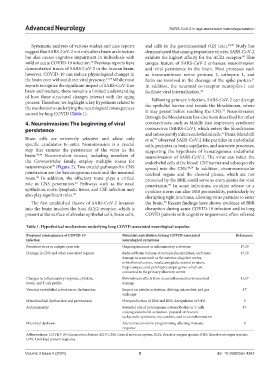
            Table 1. Hypothetical mechanisms underlying long COVID‑associated neurological sequelae

            Proposed consequences of COVID‑19        Potential contribution to long COVID‑associated   References
            infection                                neurological symptoms
            Persistent virus or antigen reservoir    Ongoing immune or inflammatory activation         17,29
            Damage in CNS and other associated regions  Reduced brain volume, structural abnormalities, and tissue   17,29
                                                     damage in areas such as the anterior cingulate cortex,
                                                     orbitofrontal cortex, insula, amygdala, ventral striatum,
                                                     hippocampus, and parahippocampal gyrus, which are
                                                     connected to the primary olfactory cortex
            Changes in inflammatory response, cytokine   Downstream effects from neuroinflammation to neuronal   11,17
            levels, and T-cell profile               damage
            Vascular endothelial activation or dysfunction   Impact on platelet activation, clotting, microclots, and gas   17
                                                     exchange
            Mitochondrial dysfunction and proteostasis  Overproduction of ROS and RNS, deregulation of UPR  9
            Autoimmunity                             Potential role of autoimmune autoantibodies or T cells   17
                                                     causing endothelial activation, postural orthostatic
                                                     tachycardic syndrome, myocarditis, and neuroinflammation
            Microbial dysbiosis                      Altered metabolomic programming affecting immune    9
                                                     response
            Abbreviations: COVID-19: Coronavirus disease-2019; CNS: Central nervous system; ROS: Reactive oxygen species; RNS: Reactive nitrogen species;
            UPR: Unfolded protein response.

            Volume 3 Issue 4 (2024)                         5                                doi: 10.36922/an.4267

