


Page 66 - AN-4-4
P. 66
Advanced Neurology                                                                 Seizure precipitants


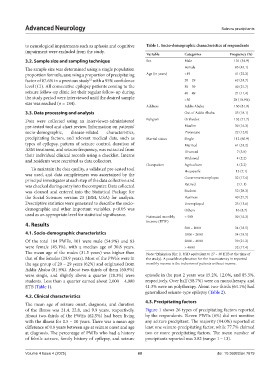
            to neurological impairments such as aphasia and cognitive   Table 1. Socio‑demographic characteristics of respondents
            impairment were excluded from the study.
                                                               Variable         Categories         Frequency (%)
            3.2. Sample size and sampling technique            Sex              Male                 101 (54.9)

            The sample size was determined using a single population            Female               83 (45.1)
            proportion formula, assuming a proportion of precipitating   Age (in years)  <19         41 (22.3)
                                       12
            factor of 87.6% in a previous study  with a 95% confidence          20 – 29              62 (33.7)
            level (CI). All consecutive epilepsy patients coming to the         30 – 39              40 (21.7)
            seizure follow-up clinic for their regular follow-up during         40 – 49              21 (11.4)
            the study period were interviewed until the desired sample          >50                 20 (10.9%)
            size was reached (n = 184).
                                                               Address          Addis Ababa          150 (81.9)
            3.3. Data processing and analysis                                   Out of Addis Ababa   33 (18.1)
            Data were collected using an interviewer-administered   Religion    Orthodox             132 (71.7)
            pre-tested tool and chart review. Information on patients’          Muslim               30 (16.3)
            socio-demographic,  disease-related  characteristics,               Protestant           22 (12.0)
            precipitating  factors,  and  relevant  medical  data,  such  as   Marital status   Single  112 (60.9)
            types of epilepsy, pattern of seizure control, duration of          Married              61 (33.2)
            ASM treatment, and seizure frequency, was extracted from            Divorced              7 (3.8)
            their individual clinical records using a checklist. Interns
            and residents were recruited as data collectors.                    Widowed               4 (2.2)
                                                               Occupation       Agriculture           4 (2.2)
              To maintain the data quality, a validated pre-tested tool         Housewife            13 (7.1)
            was used, and data completeness was ascertained by the
            principal investigator at each step of the data collection and      Government employee  32 (17.4)
            was checked during entry into the computer. Data collected          Retired               2 (1.1)
            was cleaned and entered into the Statistical Package for            Student              52 (28.3)
            the Social Sciences version  23 (IBM, USA) for analysis.            Business             40 (21.7)
            Descriptive statistics were generated to describe the socio-        Unemployed           25 (13.6)
            demographic and other important variables.  p<0.05 was              Others               16 (8.7)
            used as an appropriate level for statistical significance.  Estimated monthly   < 500    30 (16.3)
                                                               income (ETB )
                                                                        a
            4. Results
                                                                                500 – 1000           34 (18.5)
            4.1. Socio-demographic characteristics                              1000 – 2000          34 (18.5)
            Of the total 184 PWEs, 101 were male (54.9%) and 83                 2000 – 4000          39 (21.2)
            were female (45.1%), with a median age of 30.8  years.              > 4000               32 (17.4)
            The mean age of the males (31.5 years) was higher than   Note:  Ethiopian Birr (1 USD equivalent to 27 – 30 ETB at the time of
                                                                   a
            that of the females (29.9 years). Most of the PWEs were in   the study). A possible explanation for the inconsistency in reported
            the age group of 20 – 29 years (62%) and originated from   monthly income is the inclusion of patients without income.
            Addis Ababa (81.9%). About two-thirds of them (60.9%)
            were  single, and  slightly  above  a quarter  (28.3%)  were   episode in the past 2 years was 15.2%, 12.0%, and 85.3%,
            students. Less than a quarter earned about 2,000 – 4,000   respectively. Over half (58.7%) were on monotherapy, and
            ETB (Table 1).                                     41.3% were on polytherapy. About two-thirds (64.1%) had
                                                               generalized seizure-type epilepsy (Table 2).
            4.2. Clinical characteristics
            The mean age of seizure onset, diagnosis, and duration   4.3. Precipitating factors
            of the illness was 21.4, 22.8, and 9.9  years, respectively.   Figure 1 shows 26 types of precipitating factors reported
            About two-thirds of the PWEs (62.5%) had been living   by the respondents. Eleven PWEs (6%) did not mention
            with the illness for 0.5 – 10 years. There was a mean age   any seizure precipitant. The majority (94.0%) reported at
            difference of 0.8 years between age at seizure onset and age   least one seizure-precipitating factor, while 77.7% claimed
            at diagnosis. The percentage of PWEs who had a history   two or more precipitating factors. The mean number of
            of febrile seizure, family history of epilepsy, and seizure   precipitants reported was 3.82 (range: 1 – 13).


            Volume 4 Issue 4 (2025)                         60                               doi: 10.36922/an.7679

