


Page 70 - ARNM-2-3
P. 70
Advances in Radiotherapy
            & Nuclear Medicine                                       Association between PET-derived flows and angiography


            1. Introduction                                    690, GE Healthcare, USA). The stress and imaging
                                                               protocols used have been described in previous work by
            Positron emission tomography (PET) myocardial perfusion   our group. 17
            imaging (MPI) is highly accurate for the diagnosis of
            coronary artery disease (CAD) and risk assessment.  Multiple   2.2. QCA
                                                   1
            studies have evaluated the diagnostic accuracy of PET
            MPI in CAD, demonstrating that the sensitivity of PET for   Standard coronary angiographic images were analyzed
            detecting obstructive CAD is 92% and 95% for single-vessel   with at least two projections obtained per vessel
            and multivessel CAD, respectively.  PET also allows for   distribution and angles of projection optimized for
                                        2-5
            non-invasive quantification of absolute global and regional   the  cardiac  position.  In  each  patient,  luminal  diameter
            myocardial blood flow (MBF; expressed as ml/min/g) and   stenoses of the major epicardial coronary arteries were
            myocardial flow reserve (MFR; ratio of stress/rest MBF) using   clinically graded by subjective visual consensus of two
            tracers such as rubidium-82  ( Rb). Measurement of MBF   experienced operators  and then  analyzed  using  two-
                                    82
            has been shown to improve diagnostic accuracy and provides   dimensional QCA at the Yale Cardiovascular Research
            incremental prognostic information compared to measures of   Group  Angiographic Core Laboratory (QAngio XA;
            relative perfusion alone, particularly in multivessel disease. 6-10  7.4 MEDIS, Netherlands), which was applied to both
                                                               obstructive and non-obstructive atherosclerotic plaques
              Global and regional MBF are also important       from the reference vessel. Either isocenter or catheter
            prognostic tools in patients with and without obstructive   calibration was applied. Coronary lesions were analyzed
            CAD. 9,11-16  PET MPI with MBF quantification is the non-  for qualitative atherosclerotic plaque characteristics.
            invasive gold-standard modality for the diagnosis of   Diameter and length (mm) of obstruction and area
            coronary microvascular dysfunction  by quantifying   (mm ), along with percent stenosis, were measured and
                                           10
                                                                   2
            reductions in hyperemic MBF and/or MFR,  thus avoiding   then compared to visual stenosis grading. Percent stenosis
                                              10
            costly and repeated invasive testing.
                                                               was calculated as:
              Despite all the advances in the understanding of
            invasive and non-invasive coronary physiology assessment   ([1-minimal  lumen  diameter]/reference  vessel
            and global  Rb-derived MBF, there is a paucity of data on   diameter) × 100                    (I)
                     82
            the correlation between regional MBF and angiographic   Other characteristics, such as symmetry and area of
            severity of CAD, its implications for revascularization, and   plaque and the distal and proximal stenosis measurements
            its relationship to all-cause mortality. To date, there are no   were also obtained. All traced lesions were manually
            large studies evaluating the correlation between regional
            MBF/MFR and angiographic stenoses to validate its
            widespread use for referral for invasive procedures. With
            this background, our study seeks to determine the relation
            between  Rb-derived regional MBF indices and percent
                   82
            area stenosis through quantitative coronary angiography
            (QCA), and their relationship to all-cause mortality.
            2. Methods

            We performed a retrospective review of consecutive adult
            patients from the Yale Nuclear Cardiology PET lab who
                                                       82
            underwent cardiac dynamic three-dimensional (3D)  Rb
            PET/computed tomography (CT) with regadenoson stress,
            followed by coronary angiography within 3  months. We
            excluded patients with low-quality angiographic films (unable
            to  perform  QCA),  uninterpretable  MBF  measurements,
            previous coronary artery bypass graft (CABG), heart
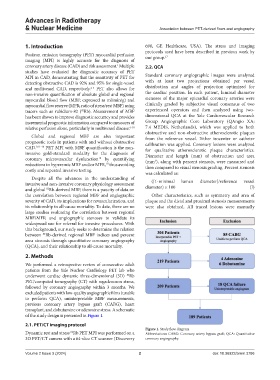
            transplant, and dobutamine or adenosine stress. A schematic
            of the study design is presented in Figure 1.

            2.1. PET/CT imaging protocol
                                                               Figure 1. Study flow diagram
            Dynamic rest and stress  Rb PET MPI was performed on a   Abbreviations: CABG: Coronary artery bypass graft; QCA: Quantitative
                               82
            3D PET/CT camera with a 64-slice CT scanner (Discovery   coronary angiography.

            Volume 2 Issue 3 (2024)                         2                              doi: 10.36922/arnm.3786

