


Page 72 - ARNM-2-3
P. 72
Advances in Radiotherapy
            & Nuclear Medicine                                       Association between PET-derived flows and angiography


            Table 1. Baseline patient characteristics (n=189)  A
            Variables                              Value (%)
            Gender (n[%])
             Female                                 82 (43)
             Male                                  107 (56.6)
             Age (Median [IQR], year)              66 (56,74)
             BMI                                     34.5
            Race (n[%])
             Black/African American                 38 (20.1)
                                                               B
             White/Caucasian                       130 (68.8)
             Hispanic/Latino                        15 (7.9)
             Other                                  6 (3.1)
             Hypertension (n[%])                   145 (77.5)
             Diabetes (n[%])                        87 (46.5)
             Hyperlipidemia (n[%])                 126 (67.4)
             Smoking (n[%])                         38 (20.3)
             Chronic renal disease (n[%])           25 (13.4)
             Peripheral vascular disease (n[%])     16 (8.6)
             Family history of CAD (n[%])           22 (11.8)  C
            Abbreviations: BMI: Body mass index; CAD: Coronary artery disease;
            IQR: Interquartile range.

            Table 2. Characteristics of stenosis in each vessel on
            quantitative coronary angiography in the full sample
            Vessels  Obstruction   Obstruction   Stenosis percent (%)
                   diameter (mm)  length (mm)
            LAD    1.60 (1.21, 1.93)  7.71 (5.13, 11.33)  29.81 (24.61, 45.00)
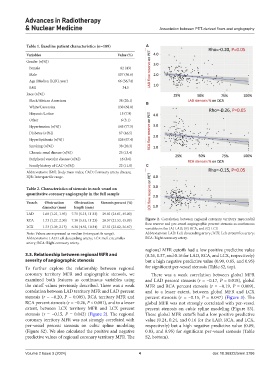
            RCA    1.73 (1.27, 2.30)  7.38 (5.45, 11.23)  28.57 (21.53, 45.09)  Figure  2. Correlation between regional coronary territory myocardial
                                                               flow reserve and per-vessel angiographic percent stenosis as continuous
            LCX    1.73 (1.39, 2.15)  6.30 (4.55, 10.34)  27.51 (23.02, 36.67)  variables in the (A) LAD, (B) RCA, and (C) LCX
            Note: Values are expressed as median (interquartile range).  Abbreviations: LAD: Left descending artery; LCX: Left circumflex artery;
            Abbreviations: LAD: Left descending artery; LCX: Left circumflex   RCA: Right coronary artery.
            artery; RCA: Right coronary artery.
                                                               regional MFR cutoffs had a low positive predictive value
            3.3. Relationship between regional MFR and         (0.26, 0.37, and 0.16 for LAD, RCA, and LCX, respectively)
            severity of angiographic stenosis                  but a high negative predictive value (0.90, 0.85, and 0.95)
            To further explore the relationship between regional   for significant per-vessel stenosis (Table S2, top).
            coronary territory MFR and angiographic stenosis, we   There was a weak correlation between global MFR
            examined both features as continuous variables using   and LAD percent stenosis (r = −0.17, P = 0.018), global
            the cutoff values previously described. There was a weak   MFR and RCA percent stenosis (r = −0.19, P = 0.009),
            correlation between LAD territory MFR and LAD percent   and to a lesser extent, between global MFR and LCX
            stenosis (r = −0.20, P = 0.005), RCA territory MFR and   percent  stenosis  (r  =  −0.15,  P  =  0.047)  (Figure  3).  The
            RCA percent stenosis (r = −0.26, P < 0.001), and to a lesser   global MFR was not strongly correlated with per-vessel
            extent, between LCX territory MFR and LCX percent   percent stenosis on cubic spline modeling (Figure S3).
            stenosis (r = −0.15,  P = 0.042) (Figure  2). The regional   These global MFR cutoffs had a low positive predictive
            coronary territory MFR was not strongly correlated with   value (0.24, 0.24, and 0.16 for the LAD, RCA, and LCX,
            per-vessel percent stenosis on  cubic  spline modeling   respectively) but a high negative predictive value (0.89,
            (Figure S2). We also calculated the positive and negative   0.83, and 0.95) for significant per-vessel stenosis (Table
            predictive values of regional coronary territory MFR. The   S2, bottom).


            Volume 2 Issue 3 (2024)                         4                              doi: 10.36922/arnm.3786

