


Page 43 - ARNM-2-4
P. 43
Advances in Radiotherapy
            & Nuclear Medicine                                             Outcomes of durations in 2D and 3D BT for CCA


            IVA of the disease, respectively. The inclusion criteria   stage, and pathology, with a matching tolerance of 0.02.
            were patients clinically diagnosed with cervical cancer,   Matching was conducted separately for the overall dataset,
            including squamous cell carcinoma, adenocarcinoma,   patients who received 2D brachytherapy, and patients who
            adenosquamous carcinoma, or small cell carcinoma, with   received 3D brachytherapy. From the overall dataset of
            clinical staging ranging from IB to IVA. Furthermore, data   649  patients, PSM yielded 162 pairs (total, 324  patients’
            were stratified according to planned external radiation   data). From the subset of 525 patients who received 2D
            dose, FIGO staging, radiation therapy technique, and   brachytherapy, PSM yielded 88 pairs (total, 176 patients’
            whether concurrent chemotherapy was administered. The   data). From the subset of 124 patients who received 3D
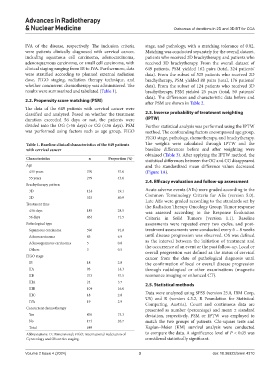
            results were summarized and tabulated (Table 1).   brachytherapy, PSM yielded 25 pairs (total, 50  patients’
                                                               data). The differences and characteristic data before and
            2.2. Propensity score matching (PSM)               after PSM are shown in Table 2.
            The data of the 649  patients with cervical cancer were
            classified and analyzed. Based on whether the treatment   2.3. Inverse probability of treatment weighting
            duration exceeded 56  days or not, the patients were   (IPTW)
            divided into the OG (>56 days) or CG (≤56 days). PSM   Further statistical analysis was performed using the IPTW
            was  performed using factors  such as  age  group,  FIGO   method. The confounding factors encompassed age group,
                                                               FIGO stage, pathology, chemotherapy, and brachytherapy.
            Table 1. Baseline clinical characteristics of the 649 patients   The weights were calculated through IPTW and the
            with cervical cancer                               baseline differences before and  after  weighting were
                                                               obtained (Table 3). After applying the IPTW method, the
            Characteristics            n       Proportion (%)  statistical differences between the OG and CG disappeared
            Age                                                and the standardized mean difference values decreased
             ≤55 years                370          57.0        (Figure 1A).
             55 years                 279          43.0
            Brachytherapy pattern                              2.4. Efficacy evaluation and follow-up assessment
             3D                       124          19.1        Acute adverse events (AEs) were graded according to the
             2D                       525          80.9        Common Terminology Criteria for AEs (version  5.0).
                                                               Late AEs were graded according to the standards set by
            Treatment time                                     the Radiation Therapy Oncology Group. Tumor response
             ≤56 days                 185          28.5        was assessed according to the Response Evaluation
             56 days                  464          71.5        Criteria in Solid Tumors (version  1.1). Baseline
            Pathological type                                  assessments  were  repeated  every  two  cycles,  and  post-
             Squamous carcinoma       596          91.8        treatment assessments were conducted every 6 – 8 weeks
             Adenocarcinoma           45           6.9         until disease progression was observed. OS was defined
                                                               as the  interval  between  the  initiation of  treatment  and
             Adenosquamous carcinoma  5            0.8
             Others                   3            0.5         the occurrence of an event or the past follow-up. Local or
                                                               overall progression was defined as the status of cervical
            FIGO stage                                         cancer from the date of pathological diagnosis until
             IB                       18           2.8         the confirmation of local or overall disease progression
             IIA                      93           14.3        through radiological or other examinations (magnetic
             IIB                      373          57.5        resonance imaging or enhanced CT).
             IIIA                     24           3.7
                                                               2.5. Statistical methods
             IIIB                     104          16.0
             IIIC                     18           2.8         Data were analyzed using SPSS (version 25.0, IBM Corp,
                                                               US)  and R  (version  4.3.2, R  Foundation  for  Statistical
             IVA                      19           2.9         Computing, Austria). Count and continuous data are
            Concurrent chemotherapy                            presented as number (percentage) and mean ± standard
             Yes                      476          73.3        deviation, respectively. PSM or IPTW was employed to
             No                       173          26.7        match the two groups of patients. Chi-square tests and
             Total                    649                      Kaplan–Meier (KM) survival analysis were conducted
            Abbreviations: D: Dimensional; FIGO: International Federation of   to compare the data. A significance level of P < 0.05 was
            Gynecology and Obstetrics staging.                 considered statistically significant.


            Volume 2 Issue 4 (2024)                         3                              doi: 10.36922/arnm.4310

