


Page 44 - ARNM-2-4
P. 44
Advances in Radiotherapy
            & Nuclear Medicine                                             Outcomes of durations in 2D and 3D BT for CCA


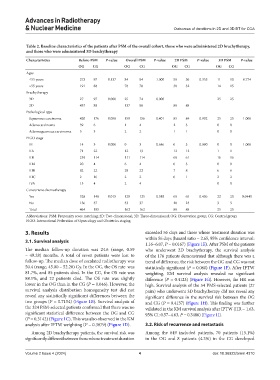
            Table 2. Baseline characteristics of the patients after PSM of the overall cohort, those who were administered 2D brachytherapy,
            and those who were administered 3D brachytherapy
            Characteristics       Before‑PSM   P‑value  Overall PSM  P‑value  2D PSM  P‑value   3D PSM  P‑value
                                  OG     CG           OG    CG            OG    CG           OG   CG
            Ages
             ≤55 years             273   97    0.137  84    84     1.000   50   56    0.355  11    10   0.774
             >55 years             191   88           78    78             38   32           14    15
            Brachytherapy
             3D                    27    97    0.000  25    74     0.000               -     25    25     -
             2D                    437   88           137   88             88   88
            Pathological type
             Squamous carcinoma    420   176   0.058  159   156    0.401   85   84    0.902  25    25   1.000
             Adenocarcinoma        39    6            1     4              2    3            0     0
             Adenosquamous carcinoma  5  3            2     2              1    1            0     0
            FIGO stage
             IB                    14    3     0.000  0     3      0.646   0    3     0.090  0     0    1.000
             IIA                   71    22           12    13             12   12           1     1
             IIB                   259   114          111   114            60   61           16    16
             IIIA                  20    4            6     4              0    3            0     0
             IIIB                  82    22           29    22             7    8            6     6
             IIIC                  2     16           2     2              0    1            2     2
             IVA                   15    4            2     4                                0     0
            Concurrent chemotherapy
             Yes                   328   148   0.015  129   125    0.589   60   65    0.406  22    20   0.0440
             No                    136   37           33    37             28   23           3     5
             Total                 464   185          162   162            88   88           25    25
            Abbreviations: PSM: Propensity score matching; 2D: Two-dimensional; 3D: Three-dimensional; OG: Observation group; CG: Control group;
            FIGO: International Federation of Gynecology and Obstetrics staging.

            3. Results                                         exceeded 56 days and those whose treatment duration was
                                                               within 56 days (hazard ratio = 2.65, 95% confidence interval:
            3.1. Survival analysis
                                                               1.16−6.07, P = 0.0167) (Figure 1E). After PSM of the patients
            The median follow-up duration was 24.6 (range, 0.59   who underwent 2D brachytherapy, the survival analysis
            – 49.28) months. A  total of seven patients were lost to   of the 176 patients demonstrated that although there was a
            follow-up. The median dose of escalated radiotherapy was   trend of difference, the risk between the OG and CG was not
            50.4 (range, 45.00 – 52.20) Gy. In the OG, the OS rate  was   statistically significant (P = 0.080) (Figure 1F). After IPTW
            81.7%, and 85 patients died. In the CG, the OS rate was   weighting, KM survival analysis revealed no significant
            88.1%, and 22  patients died. The OS rate was slightly   difference (P = 0.4123) (Figure 1G). However, the HR was
            lower in the OG than in the CG (P = 0.046). However, the   high. Survival analysis of the 54 PMS-selected patients (27
            survival analysis distribution homogeneity test did not   pairs) who underwent 3D brachytherapy did not reveal any
            reveal any statistically significant differences between the   significant difference in the survival risk between the OG
            two groups (P = 0.7154) (Figure 1B). Survival analysis of   and CG (P = 0.4137) (Figure 1H). This finding was further
            the 324 PSM-selected patients confirmed that there was no   validated in the KM survival analysis after IPTW (HR = 1.63,
            significant statistical difference between the OG and CG   95% CI: 0.57−4.63, P = 0.3486) (Figure 1I).
            (P = 0.3142) (Figure 1C). This was also observed in the KM
            analysis after IPTW weighting (P = 0.3079) (Figure 1D).  3.2. Risk of recurrence and metastasis

              Among 2D brachytherapy patients, the survival risk was   Among  the  649  included  patients,  70  patients  (15.1%)
            significantly different between those whose treatment duration   in the OG and 8  patients (4.3%) in the CG developed


            Volume 2 Issue 4 (2024)                         4                              doi: 10.36922/arnm.4310

