


Page 95 - ARNM-2-4
P. 95
Advances in Radiotherapy
            & Nuclear Medicine                                        Malignant peripheral nerve sheath tumor: A case report


            defecation or urination disorders. No special signs were   lesion exposed uniform spin hyalinization stroma. The
            noted on clinical examination, except for paralysis in both   tumor stained positive for S100 in immunohistochemistry
            lower extremities, with muscle strength of 4/5.    (Figure 5). These features indicated a malignant epithelioid
              Her blood cell counts and blood biochemistry test results   peripheral nerve sheath tumor.
            were within the normal range. Magnetic resonance imaging   The patient also underwent esophagogastroduodenoscopy
            (MRI) of the lumbar and sacral spine revealed multiple   and colorectal endoscopy, which revealed no abnormal lesions
            hyperintense lesions in T2-weighted imaging (T2WI) and   suggestive of malignancy.
            fluid-attenuated inversion recovery, rim enhancement in
            the vertebral body, and vertebral pedicle on both sides of L4.   A         B
            The lesions, including a large 22 × 12-mm focus, exhibited
            substantial  spinal  membrane  and  soft-tissue  infiltration,
            causing nerve compression at the L4 level. The area of
            damage to the left L2 pedicle was comparable, measuring
            14 × 17  mm. The D11–D12 vertebral body had foci of
            hyperintense lesions on T2WI and strong gadolinium
            enhancement. The invasive D12 lesion damaged the bone
            cortex and grew into the spinal canal (Figure 1).
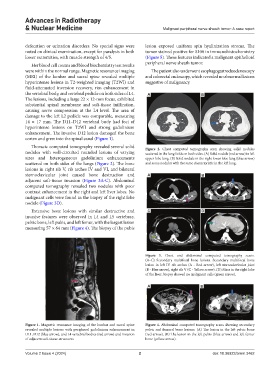
              Thoracic computed tomography revealed several solid   Figure  2. Chest computed tomography scan showing solid nodules
            nodules with well-circuited rounded lesions of varying   scattered in the lung fields on both sides. (A) Solid nodule (red arrow) in left
            sizes and heterogeneous gadolinium enhancements    upper lobe lung. (B) Solid nodule in the right lower lobe lung (blue arrow)
            scattered on both sides of the lungs (Figure 2). The bone   and some nodules with the same characteristic in the left lung.
            lesions in right rib V, rib arches IV and VI, and bilateral
            sternoclavicular joint caused bone destruction and   A                     B
            adjacent soft-tissue invasion (Figure  3A-C). Abdominal
            computed tomography revealed two nodules with poor
            contrast enhancement in the right and left liver lobes. No
            malignant cells were found in the biopsy of the right lobe
            nodule (Figure 3D).
              Extensive bone lesions with similar destructive and   C                  D
            invasive features were observed in L4 and L5 vertebrae,
            pelvic bone, left pubis, and left femur, with the largest lesion
            measuring 57 × 64 mm (Figure 4). The biopsy of the pubis


                                                               Figure  3. Chest and abdominal computed tomography scans.
                                                               (A–C)  Secondary multifocal bone lesions. Secondary multifocal bone
                                                               lesion in left IV rib arches (A - Red arrow), left sternoclavicular joint
                                                               (B - Blue arrow), right rib V (C - Yellow arrow). (D) Mass in the right lobe
                                                               of the liver; biopsy showed no malignant cells (green arrow).

                                                                A                     B


            Figure 1. Magnetic resonance imaging of the lumbar and sacral spine   Figure 4. Abdominal computed tomography scans showing secondary
            revealed multiple lesions with peripheral gadolinium enhancement in   pelvic and femoral bone lesions. (A) The lesion in the left pelvic bone
            D11, D12 (blue arrow), and L4 vertebral bodies (red arrow) and invasion   (red arrow). (B) The lesion in the left pubis (blue arrow) and left femur
            of adjacent soft-tissue structures                 bone (yellow arrow).


            Volume 2 Issue 4 (2024)                         2                              doi: 10.36922/arnm.3462

