


Page 91 - ARNM-2-4
P. 91
Advances in Radiotherapy
            & Nuclear Medicine                                                    Dose prescription and reporting in SRS


              For the conformity index (CI), a general guideline   The  analysis  and  comparison  of  dose-volumetric
            suggests maintaining values below 1.20 for SBRT/SRS   parameters strongly depend on the definition of the
            plans.  Our findings revealed a mean CI of 1.17 (standard   prescription dose. Some institutions use D , D , D , or
                11
                                                                                                 100
                                                                                                         80
                                                                                                      95
            deviation: 0.07), which aligns with this recommendation.  D  as the dose prescription for SBRT/SRS plans. However,
                                                                50
                                                               these doses may  be addressed to PTV or gross tumor
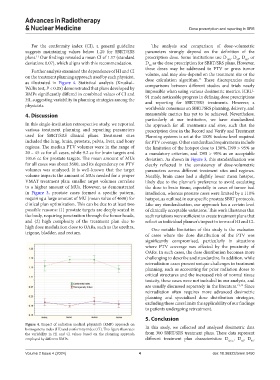
              Further analysis examined the dependence of HI and CI
            on the treatment planning approach used by each physicist,   volume, and may also depend on the treatment site or the
                                                               dose  calculation  algorithm.   These  discrepancies  make
                                                                                      12
            as illustrated in  Figure  4. Statistical analysis (Kruskal–  comparisons between different studies and trials nearly
            Wallis test, P < 0.05) demonstrated that plans developed by   impossible when using various dosimetric metrics. ICRU-
            RMPs significantly differed in combined values of CI and   91 made noticeable progress in defining dose prescriptions
            HI, suggesting variability in planning strategies among the   and reporting for SBRT/SRS treatments. However, a
            physicists.
                                                               worldwide consensus on SBRT/SRS planning, delivery, and
            4. Discussion                                      measurable metrics has yet to be achieved. Nevertheless,
                                                               particularly at  our institution,  we have standardized
            In this single-institution retrospective study, we reported   the approach for all treatments and sites, such that the
            various  treatment  planning  and  reporting  parameters   prescription dose in the Record and Verify and Treatment
            used for SBRT/SRS clinical plans. Treatment sites   Planning systems is set at the 100% isodose level required
            included the lung, brain, prostate, pelvis, liver, and bony   for PTV coverage. Other standardized requirements include
            regions. The median PTV volumes were in the range of   the limitation of the hotspot dose to 130%, D99 > 95% as
            20 – 45 cc for all cases, while 9.2 cc for brain targets and   a  mandatory  criterion,  and  D95  >  95%  as  an  acceptable
            105.6 cc for prostate targets. The mean amount of MUs   deviation. As shown in Figure 3, this standardization was
            for all cases was about 3600, and its dependency on PTV   clearly reflected in the consistency of dose-volumetric
            volumes was analyzed. It is well-known that the target   parameters across different treatment sites and regimes.
            volume impacts the amount of MUs needed for a proper   Notably, brain cases had a slightly lower mean hotspot,
            VMAT treatment plan: smaller target volumes correlate   likely  due to  the planner’s  preference  to avoid escalating
            to a higher amount of MUs. However, as demonstrated   the dose to brain tissue, especially in cases of tumor bed
            in  Figure  3, prostate cases formed a specific pattern,   irradiation, whereas prostate cases were limited by a 110%
            requiring a large amount of MU (mean value of 4600) for   hotspot, as outlined in our specific prostate SBRT protocols.
            clinical plan optimization. This can be due to at least two   Like any standardization, our approach has a certain level
            possible reasons: (1) prostate targets are deeply seated in   of clinically acceptable variations. This work illustrates that
            the body, requiring penetration through the femur heads,   such variations were sufficient to create treatment plans that
            and (2) high complexity of the treatment plan due to   reflect an individual planner’s impact in terms of HI and CI.
            high dose modulation close to OARs, such as the urethra,   One notable limitation of this study is the exclusion
            trigone, bladder, and rectum.                      of cases where the dose distribution of the PTV was
                                                               significantly compromised, particularly in situations
                                                               where PTV coverage was affected by the proximity of
                                                               OARs. In such cases, the dose distribution becomes more
                                                               challenging to describe and standardize. In addition, while
                                                               reirradiation cases present unique challenges in treatment
                                                               planning, such as accounting for prior radiation doses to
                                                               critical structures and the increased risk of normal tissue
                                                               toxicity, these cases were not included in our analysis, and
                                                               are usually discussed separately in the literature. 13,14  Since
                                                               reirradiation  often  requires  more  advanced  dosimetric
                                                               planning and specialized dose distribution strategies,
                                                               excluding these cases limits the applicability of our findings
                                                               to patients undergoing retreatment.

                                                               5. Conclusion
            Figure  4. Impact of radiation medical physicist’s (RMP) approach on
            homogeneity index (HI) and conformity index (CI). This figure illustrates   In this study, we collected and analyzed dosimetric data
            the variability in HI and CI values based on the planning approach   from 300 SBRT/SRS treatment plans. These data represent
            employed by different RMPs.                        different treatment plan characteristics: D 0.1cc , D , D ,
                                                                                                            95
                                                                                                        50
            Volume 2 Issue 4 (2024)                         4                              doi: 10.36922/arnm.5450

