


Page 41 - ARNM-3-1
P. 41
Advances in Radiotherapy
            & Nuclear Medicine                                                 EZH2 inhibition in ARID1A-deficient TNBC


            of most breast cancer cells because total EZH2 protein
            levels remain unaffected. This observation suggests that
            the expression of the EZH2 protein itself, rather than
            its methyltransferase activity, may be crucial for the
            occurrence and development of breast cancer, including
            TNBC.  Therefore, designing degradation molecules
                  42
            that selectively reduce EZH2 protein levels may offer an
            effective treatment strategy for EZH2-dependent tumors
            such  as  TNBC.   MS1943,  an  EZH2  selective  degrader,
                         42
            has been shown to suppress TNBC tumor growth
            in vivo.  Combining enzymatic inhibition and depletion
                  43
            or degradation of EZH2 is another potential strategy
            for treating TNBC with high EZH2 expression.  Mei
            et al.  showed that IHMT-337, an irreversible inhibitor
                44
            of EZH2, exerts its effects through covalent modification
            of the EZH2 protein, leading to a sustained inhibition of
                                    44
            its  methyltransferase  activity.   This  inhibition  results  in
            the downregulation of target genes associated with cell
            proliferation and survival, particularly those involved in
            regulating  cyclin-dependent  kinase  4  transcription,  thus
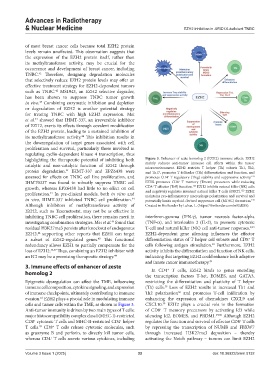
            highlighting the therapeutic potential of inhibiting both   Figure 3. Enhancer of zeste homolog 2 (EZH2) immune effects. EZH2
            catalytic and  non-catalytic function  of EZH2  through   mainly  reduces  anti-tumor  immune  cell  effects  within  the  tumor
                                                               microenvironment. EZH2 restricts T helper (Th) subsets Th1, Th2,
            protein degradation.  IHMT-337 and EPZ6438 were    and Th17, promotes T follicular (Tfh) differentiation and function, and
                             44
            assessed for effects on TNBC cell line proliferation, and   promotes CD4  T regulatory (Treg) stability and suppressive activity.
                                                                                                            123
                                                                        +
            IHMT0337  was  found  to  robustly  suppress  TNBC  cell   EZH2 promotes CD8  T memory (Tmem) precursors while reducing
                                                                             +
                                                                                   123
                                                                  +
            growth, whereas EPZ6438 had little to no effect on cell   CD8  T effector (Teff) function.  EZH2 inhibits natural killer (NK) cells
                                                                                                        123
                      44
            proliferation.  In pre-clinical models, both  in  vitro  and   and negatively regulates invariant natural killer T cells (iNKT).  EZH2
                                                               maintains pro-inflammatory macrophage polarization and survival and
            in vivo, IHMT-337 inhibited  TNBC cell proliferation.    potentially limits myeloid-derived suppressor cell (MDSC) formation.
                                                         44
                                                                                                            123
            Although inhibitors of methyltransferase activity of   Created in BioRender by Lukas, L. (https://BioRender.com/o93d285).
            EZH2, such as Tazemetostat, may not be as effective in
            inhibiting TNBC cell proliferation, there remains merit in   interferon-gamma (IFN-γ),  tumor  necrosis  factor-alpha
            investigating combination strategies. Mei et al.  found that   (TNF-α), and interleukin 2 (IL-2), to promote cytotoxic
                                                44
            residual H3K27me3 persists after knockout of endogenous   T-cell and natural killer (NK) cell anti-tumor responses.
                                                                                                           9,13
            EZH2,  supporting other reports that EZH1 can target   EZH2-dependent gene silencing influences the effector
                 44
            a subset of EZH2-regulated genes.  This functional   differentiation status of T helper cell subsets and CD8  T
                                           45
                                                                                                           +
            redundancy allows EZH1 to partially compensate for the   cells following antigen stimulation.  Furthermore, EZH2
                                                                                           48
            loss of EZH2. 46,47  Thus, combining an EZH2 inhibitor with   activity inhibits the differentiation and function of NK cells,
            an ICI may be a promising therapeutic strategy. 44  indicating that targeting EZH2 could enhance both adaptive
                                                               and innate cancer immunotherapy. 49
            3. Immune effects of enhancer of zeste                      +
                                                                 In  CD4   T  cells,  EZH2  binds  to  genes  encoding
            homolog 2                                          the transcription factors T-bet, EOMES, and GATA3,
            Epigenetic dysregulation can affect the TME, influencing   restricting the differentiation and plasticity of T helper
            immune cell composition, cytokine signaling, and expression   (Th) cells.  Loss of EZH2 results in increased Th1 and
                                                                       39
            of immune checkpoints, ultimately contributing to immune   Th2 polarization  and promotes T-cell infiltration by
                                                                             39
            evasion.  EZH2 plays a pivotal role in modulating immune   enhancing the expression of chemokines CXCL9 and
                  16
            cells and tumor cells within the TME, as shown in Figure 3.   CXCL10.  EZH2 plays a crucial role in the formation
                                                                      39
            Anti-tumor immunity is driven by two main types of T cells:   of  CD8   T  memory  precursors  by activating  Id3  while
                                                                     +
            major histocompatibility complex class I (MHC-I)-restricted   silencing Id2, EOMES, and PRDM1. 39,50  Although EZH2
            CD8  cytotoxic T cells and MHC-II-restricted CD4  helper   regulates the function and survival of effector CD8  T cells
                                                                                                       +
                                                    +
               +
            T cells.  CD8  T cells release cytotoxic molecules, such   by  repressing  the  transcription  of  NUMB  and  FBXW7
                       +
                  39
            as granzyme B and perforin, to directly kill tumor cells,   through increased H3K27me3 deposition – thereby
            whereas CD4  T cells secrete various cytokines, including   activating the Notch pathway – tumors can limit EZH2
                       +
            Volume 3 Issue 1 (2025)                         33                             doi: 10.36922/arnm.5132

